
- - -
- hours mins seconds
to get your checks by
Tomorrow, Nov. 20th

 0
You have no items in your shopping cart.
Shareholder Distribution Checks: Order, Limits and the Paper Trail
Last updated: November 19, 2026
Everything written about owner distributions explains what they are and how they are taxed. Almost nothing explains the part owners actually get stuck on, which is what you do on the Tuesday afternoon you decide to take thirty thousand out of the company.
Quick Summary
A distribution moves money the company already earned to the people who own it. A reasonable wage has to be paid first where the shareholder works in the business. How much you can take is limited by two things: your basis, and a state law solvency test. The paper trail then runs from the decision to the payment to the stub.
- Reasonable compensation comes first where a shareholder works in the business.
- Officer pay is wages, not a distribution and not a loan.
- Distributions reduce your basis, and anything above it becomes a gain.
- State law sets a solvency test that decides whether it is lawful at all.
- Directors can be personally liable for an unlawful distribution.
- The record is the stub, because the software label is not the legal character.
Four words get used interchangeably and mean four different things.
| Payment | Who takes it | How it is treated |
|---|---|---|
| Salary | A shareholder who works in the business | Wages, with withholding and a pay statement |
| Owner draw | A sole proprietor or a partner in an LLC | A withdrawal of owner equity, not payroll |
| Distribution | A shareholder of a pass through corporation | Measured against stock basis |
| Dividend | A shareholder of a taxed corporation | Paid out of earnings and profits, and reported |
Nothing here is tax or legal advice. The federal treatment, your state's corporate law and your own governing documents all bear on this, so your accountant and your attorney are the people to settle any of it with.
On the mechanics, business checks let the stub carry the period, the ownership share and the approval reference behind a payment like this.
What this guide covers
- What is a distribution?
- Do you have to run payroll first?
- How much can you actually take?
- When is a distribution not lawful?
- What happens to the directors?
- How do you actually pay it?
- What should the check and stub record?
What is a distribution?
A transfer of value from the company to its owners for no consideration. One state's corporations code defines it broadly as the transfer of cash or property by a corporation to its shareholders, which usefully captures the fact that it does not have to be money.
A dividend is narrower. Federal law defines it as any distribution of property made by a corporation to its shareholders out of its earnings and profits, and federal guidance describes dividends as distributions of earnings and profits paid by a corporation to stockholders.
The label in your accounting software decides nothing. Booking a payment as a distribution does not make it one, and booking a wage payment as a distribution does not change what it was.
Do you have to run payroll first?
If you work in the business, yes. Federal guidance states that S corporations must pay reasonable compensation to a shareholder employee before non wage distributions may be made. That is the sequence, and it is the single most examined point in this whole area.
The consequence of skipping it is specific. The same guidance confirms that the agency has the authority to reclassify payments made to shareholders from non wage distributions. So a payment you called a distribution can come back as wages, with tax and penalties attached.
An officer is not outside this. Federal guidance states that generally, an officer of a corporation is an employee of the corporation. Pay for services should be treated as wages, and not as distributions of cash and property or loans to shareholders.
- Set the wage before the year starts, on a defensible basis.
- Run it through payroll properly, with statements and filings.
- Keep the reasoning on file, not just the number.
- Take distributions after that, not instead of it.
- Never label a wage as a loan to avoid the payroll.
Our guide to payroll checks covers the wage side of the same arrangement.
How much can you actually take?
Two separate limits apply, and they come from different places. The first is your basis. Federal guidance states that only non dividend distributions reduce stock basis, and that a non dividend distribution in excess of stock basis is taxed as a capital gain.
The statute behind that is explicit. A distribution is not included in gross income to the extent that it does not exceed the adjusted basis of the stock, and any excess shall be treated as gain from the sale or exchange of property.
Work out your basis before you decide the amount, not in March when the return is being prepared. An owner who takes a large distribution in a loss year is the classic case of a surprise gain.
When is a distribution not lawful?
When the company cannot afford it on the test your state applies. This is the part almost nobody covering the subject mentions, and it is the part with personal consequences.
California applies a balance sheet test. Immediately after the distribution, the value of the corporation's assets would have to equal or exceed the sum of its total liabilities. Delaware works from surplus instead. It allows payment out of surplus, and provides that in case there shall be no such surplus, out of its net profits.

Several owners paid at once go faster on three per page stock. See blank checks three per page for that format.
Do distributions have to be equal?
In a pass through corporation with one class of stock, they generally follow ownership proportions. Paying one shareholder a different ratio is not a bookkeeping choice. It raises a question about the share structure itself.
Where the timing genuinely differs, record it as a timing difference and square it within the year. Then the proportions hold even though the dates do not.
What happens to the directors?
They can be made to repay it personally. Delaware provides that directors who willfully or negligently approve an unlawful dividend are liable to the full amount of the dividend unlawfully paid. California goes further on form. Directors who approve a distribution contrary to its rules are jointly and severally liable to the corporation.
That is the reason the paperwork exists. A recorded decision showing the test was considered is the difference between a judgment call and a negligent one, and it costs ten minutes.
Should there be a written resolution?
There is no single federal rule requiring one, and the position varies by state and by your own bylaws. Treat it as strongly recommended practice rather than a universal legal duty, and check your own documents.
A short written consent naming the date, the amount, the per share figure and a note that the solvency test was considered is enough. Sole owner companies need it most, because there is nobody else to confirm the decision later.
How do you actually pay it?
By a payment from the company account to the shareholder, recorded as what it is. That sounds obvious, and it is where most of the real damage happens, because owners tend to take distributions as a series of untidy transfers instead.
| Step | What it produces |
|---|---|
| Confirm payroll has run | Evidence the wage came first |
| Check basis and the solvency test | A defensible amount |
| Record the decision in writing | The approval the stub refers to |
| Write one item per shareholder | A clean, traceable payment |
| Complete the stub fully | The record that survives a later review |
Never pay personal bills straight from the company account and call it a distribution afterwards. It mixes two sets of money, it is invisible on the ledger until somebody reconstructs it, and it is the fastest route to an argument about whether the company is really separate from you.
Our guide to check signing policy covers approval limits where more than one owner can move money.
What about a shareholder loan instead?
A loan is a different animal and needs to look like one. That means a written note, a rate, a repayment schedule and actual repayments. A loan that is never repaid and never documented tends to get treated as what it functionally was.
Keep the repayments visible too. A note with a schedule nobody follows is weaker evidence than no note at all, because it shows the terms were set and then ignored. Pay the installments by a traceable item and record each one against the note.
How often should distributions be taken?
On a set rhythm rather than on demand. Quarterly works for most small companies. Monthly works where the cash is steady.
What causes trouble is the ad hoc version. An owner who takes money whenever the balance looks healthy ends up with dozens of small transfers and no record of why any of them happened. A fixed date forces the three checks to be made each time.
What should the check and stub record?
Six fields, and the last two are the ones nobody writes. A distribution looked at two years later should explain itself without anybody opening the minute book.
- The shareholder's name, as the share register holds it.
- The date and the period the distribution relates to.
- The amount, matching the payment exactly.
- The word distribution, rather than a general description.
- The ownership percentage the figure was calculated on.
- The approval reference, pointing to the written decision.
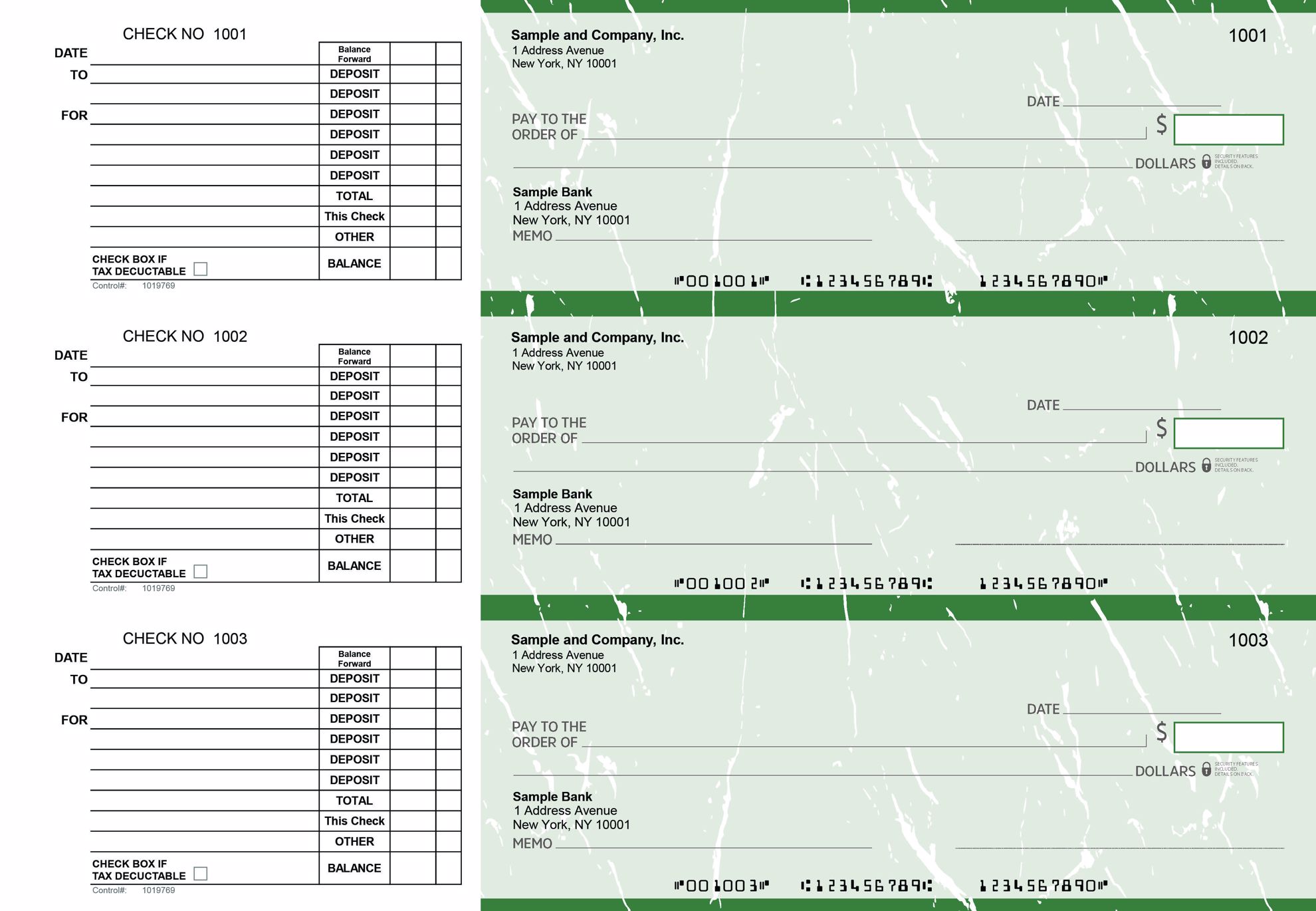
A bound book keeps the approval reference attached to the payment. See manual three on a page business checks for that format.
What gets reported afterwards?
That depends on the entity. Distributions from a pass through corporation flow through the owner's share of profit rather than being taxed again as they are paid, which is why owners are often surprised to be taxed on profit they never withdrew.
A taxed corporation paying dividends has a reporting duty instead. Federal guidance tells shareholders they should receive the dividend reporting form from each payer. The filing instructions set the threshold at ten dollars or more in money or other property.
Can you take a distribution to pay your own tax bill?
Commonly, yes, and it is one of the main reasons owners take them. The tax on a pass through profit falls on the owner personally whether or not any cash moved, so a distribution is often how the cash gets to where the bill is.
Run it through the same process as any other distribution. Same test, same written decision, same stub detail, so the payment reads as a distribution rather than as a company expense.
Related reading
- Check register covers the record a distribution is traced through.
- Payroll checks covers the wage that has to come first.
- Check signing policy covers who may approve a payment to an owner.
- Who signs a business check covers signing authority in a small corporation.
What to do next
Before the next distribution, write the three checks you will make every time on a single sheet: payroll has run, basis supports it, the company stays solvent afterwards. That sheet is what turns an informal transfer into a defensible decision.
Then pay it as a proper item with a proper stub. Business checks carry the stub space an approval reference needs, and high security business checks suit the larger payments owners tend to take.
About the Author
Owner managed companies order from us in the weeks before a year end, and the conversation always arrives at the same place. They have been told by an accountant to stop moving money by transfer with no description and to start writing proper items instead. A stub with the share percentage printed beside the amount is what that advice looks like in practice.
The points above on reasonable compensation, reclassification, stock basis, solvency tests and director liability come from federal tax guidance, the Internal Revenue Code and the corporate statutes of California and Delaware. Those states are examples. Your own state and your governing documents decide what applies to you.