
- - -
- hours mins seconds
to get your checks by
Tomorrow, Nov. 10th

 0
You have no items in your shopping cart.
Returned Check: What Happens When a Customer Payment Comes Back
Last updated: November 9, 2026
You banked the payment, marked the invoice paid, and moved on. Nine days later the money disappears from the account along with a fee, and the invoice is open again. It is an unpleasant surprise, and it is also an ordinary one that has a clear order of steps.
Quick Summary
A returned check reverses the payment, not the debt. Your bank can take the credit back because the settlement it gave you was provisional, and the person who wrote the check remains obliged to pay it. Those are two separate rights, and keeping them separate is what gets the money back.
- The credit was provisional until the paying bank settled finally.
- Charge-back can happen whether or not the bank can return the item itself.
- A midnight deadline applies to the returning bank, with liability for delay.
- The drawer still owes you, on the terms of the item as issued.
- Redepositing blind usually fails twice and costs a second fee.
- One return is a bad week, two is a pattern worth acting on.
The reason given on the advice tells you which problem you are dealing with.
| Reason given | What it usually means | Sensible next step |
|---|---|---|
| Insufficient funds | Timing, often a payment run that landed first | Agree a date, then redeposit or take another method |
| Account closed | The account no longer exists | Do not redeposit, ask for a replacement payment |
| Stop payment | A dispute you may not know about | Call before chasing, there is a reason behind it |
| Signature or endorsement issue | A paperwork fault, not a funding one | Fix the defect and present it again |
| Refer to maker | The paying bank is not explaining | Ask the customer directly, politely and early |
Read this as background rather than as advice. It is not legal, banking or collection guidance. What you may charge and how you may chase payment are set by your state's law and your own contracts, and your attorney is the person to confirm both.
On the paying side, business checks are printed with a stub that records what each payment settles, which is the detail missing when a payment has to be reconstructed later.
What this guide covers
- What does a returned check actually mean?
- Can the bank take the money back?
- Does the customer still owe you?
- Should you redeposit it?
- How do you ask without damaging the relationship?
- What should change in your process?
- How should the reversal be recorded?
What does a returned check actually mean?
It means the item was not finally paid by the bank it was drawn on, so the credit your bank gave you was never permanent. Deposits of this kind are provisional until the paying bank settles, and the gap between those two moments is where the surprise lives.
That lag is the reason a payment can look complete in your ledger for over a week and still unwind. Nothing went wrong in your process. The money simply never finished arriving.
Can the bank take the money back?
Yes, and the right is explicit. Where a collecting bank gave provisional settlement and did not receive final settlement, the Uniform Commercial Code allows it to revoke the settlement it gave, charge back the amount of any credit given for the item to your account, or obtain a refund from you, and it may do so whether or not it is able to return the item.
Is the bank under a deadline?
It is. The same section requires the bank to return the item or send notice by its midnight deadline, or within a longer reasonable time after it learns the facts. A bank that acts late keeps its remedies but becomes liable for any loss resulting from the delay.
There is also an end point. Those rights terminate if and when a settlement for the item received by the bank is or becomes final, which is why an item that has been quiet for a long time is usually safe.
Good records are what make a disputed payment provable. See blank checks on the bottom for stock with room to write them.
Does the customer still owe you?
Yes, and this is the part businesses forget while they are annoyed about the fee. The code says that if an unaccepted draft is dishonored, the drawer is obliged to pay the draft according to its terms at the time it was issued, and that the obligation is owed to a person entitled to enforce it.
In plain terms, the failed check did not cancel anything. The invoice is live, the debt is unchanged, and you now hold a document showing the customer tried to pay and the payment did not complete.
Does that change if the item was certified?
It does. Acceptance by a bank releases the person who wrote the item, and the code applies that release whenever and however the acceptance was obtained. It is one reason a certified or bank issued item sits in a category of its own.
Should you redeposit it?
Only with information. A second deposit on the same day the first one failed is a coin toss that usually costs another fee, and it annoys a customer who was already going to fix it.
- Read the return reason first, because it decides whether redepositing is sensible at all.
- Call the customer rather than emailing, and ask when funds will be in place.
- Agree a specific date and say you will deposit on it.
- Never redeposit on a closed account or where a stop payment was placed.
- Record the second attempt against the same invoice so the history stays readable.
Deposit items promptly as a general habit. The code carries a rule aimed at a check not presented for payment or given to a depositary bank for collection within thirty days after its date, under which a drawer who loses funds because the drawee suspends payments can discharge the obligation by assigning its rights against that bank.
How do you ask without damaging the relationship?
By assuming the ordinary explanation until you have reason not to. Most returned items come from a payment run landing in the wrong order, not from anyone trying to avoid paying, and the first call sets the tone for whether you keep the account.
- Call the person you normally deal with, not the accounts inbox.
- Lead with the facts, the item number, the date and the reason given.
- Ask what happened before explaining what you want.
- Offer two routes, a redeposit date or a different payment method.
- Confirm in writing the same day, briefly and without heat.
Save the formal tone for the second failure. A business that handles the first one quietly is usually the supplier that gets paid first next time, which is worth more than the fee you were going to argue about.
What should change in your process?
Two things, and neither is about distrusting customers. The first is knowing when a deposit is genuinely settled. The second is making sure a reversal is noticed by a person rather than discovered at month end.
- Do not treat a deposit as settled on the day the balance moves.
- Watch for reversals weekly, matched against open invoices.
- Set a rule for releasing goods against cleared funds above a stated value.
- Keep the returned item and the advice together in the customer file.
- Review repeat offenders quarterly, not case by case in a bad mood.
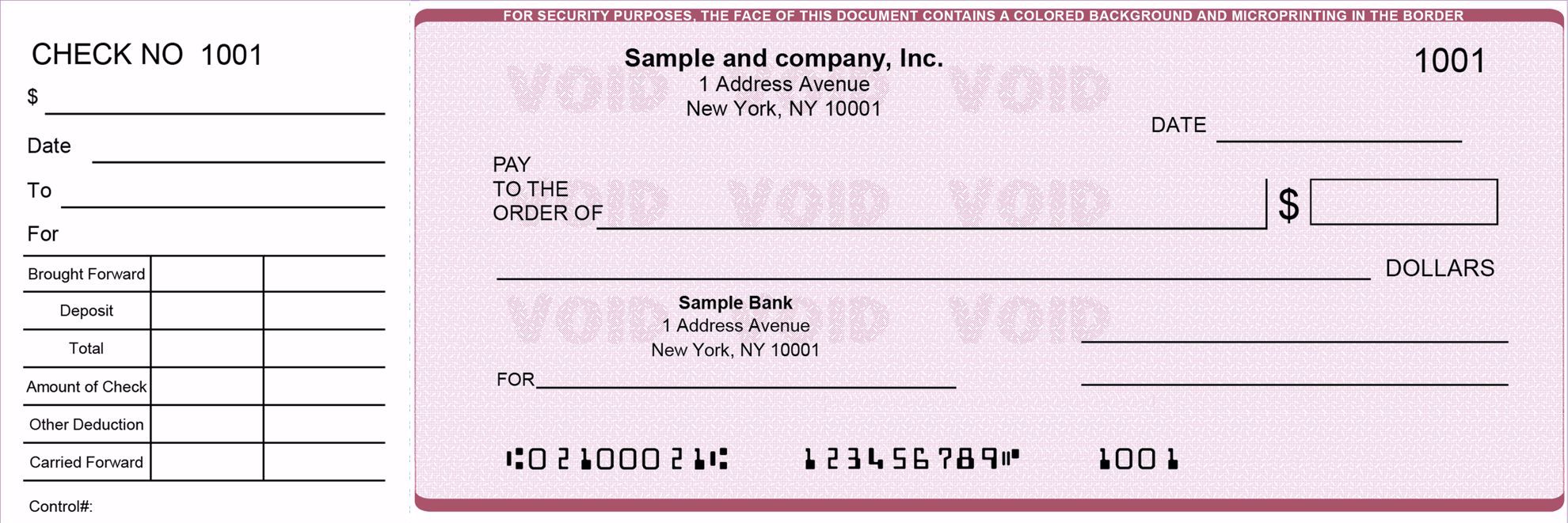
Smaller customers often pay from personal stock. See personal checks for that format.
How should the reversal be recorded?
As a reversal of that specific payment, against that specific invoice. The habit that causes trouble is posting the charge-back as a bank fee or a general adjustment, because the invoice then stays closed and nobody chases it.
| What to record | Why it matters later |
|---|---|
| The item number and date | Identifies which payment unwound |
| The reason given on the advice | Decides whether a second attempt is sensible |
| The invoice reopened | Puts the balance back in your aged debt report |
| The bank fee charged to you | Evidence of your actual cost if you recharge it |
| The date and outcome of your call | Shows the account was handled, not ignored |
Reopen the invoice the same day. A reopened balance gets chased by the normal process, and an unrecorded one waits for someone to notice a gap in the bank reconciliation weeks later.
What if the customer has already paid again?
Match the new payment to the reopened invoice rather than treating it as a credit on account. A duplicate credit sitting on a customer record is how a business ends up refunding money it was genuinely owed, and it is remarkably hard to unpick a year later.
Related reading
- Check register covers recording a reversal against the original item.
- How long is a business check good for covers what happens to an item nobody banks.
- How to endorse a check covers the endorsement faults that cause returns.
- How to fill out a business deposit slip covers getting the deposit right first time.
What to do next
Pull your last three months of bank activity and look for reversals you did not notice at the time. If any of them are still sitting as paid invoices in your ledger, that is the gap worth closing this week.
Then look at the stock you pay on, since the same habits apply in reverse. Business checks are printed with the stub detail that makes a payment traceable from either end.
About the Author
Because we supply the stock that both sides of this use, we hear both versions of the story. The customer whose payment failed is usually mortified. The supplier is usually more worried about the relationship than the money. Both handle it better knowing the rules.
The charge-back and drawer obligation points here follow the Uniform Commercial Code articles on bank deposits and collections and on negotiable instruments. Your state's enactment governs, and what you may charge or claim is a question for your counsel.