
- - -
- hours mins seconds
to get your checks by
Tomorrow, Nov. 19th

 0
You have no items in your shopping cart.
Paying Business Taxes by Check: Payee Wording, Vouchers and Proof
Last updated: November 18, 2026
Paying business taxes by check feels like the one part of the process that cannot go wrong. It can. The payee wording is not what most people write, one category of payment cannot go by check at all, and the proof you need is not the canceled item.
Quick Summary
You can still pay most federal business taxes by check, although electronic payment is now the default expectation. The payee wording differs between the agency's web guidance and its own form instructions. Four identifying details belong on the item, nothing should be stapled to it, and federal tax deposits cannot be paid by check at all.
- Electronic is now the default, with checks surviving as an exception.
- Four details go on the check, including the form and the period.
- Use your employer number, not a personal one, on a business payment.
- Never staple or clip the payment to anything.
- Deposits must go electronically, which is the exception that catches people.
- The postmark is the payment date, if the envelope is right.
Different returns want different wording and different vouchers, which is where most of the errors live.
| Payment | What goes on the check | Voucher |
|---|---|---|
| Quarterly payroll return | Employer number, the form name, the tax period | The matching payment voucher, enclosed not attached |
| Owner's estimated tax | The year, the form name and the taxpayer number | The estimated tax voucher for that period |
| Balance due with a notice | The notice number and the period it covers | None, but send the notice stub |
| Corporate deposits | Not applicable | None, because these must go electronically |
This is general information on payment mechanics and not tax advice. Payment rules, addresses and thresholds change, and state rules differ from federal ones, so confirm anything here with current official guidance and with your accountant before you post a payment.
On the item itself, business checks give you a stub with room for the form name and the period, which is the record you will want if a payment goes astray.
What this guide covers
- Can you still pay by check?
- Who do you make it payable to?
- What exactly goes on the check?
- Which voucher goes with which return?
- What can you not pay by check?
- How do you prove you paid on time?
- What if it is never cashed or goes to the wrong year?
Can you still pay by check?
Yes, and the official payment options list continues to show check or money order as accepted for all tax payment types. What has changed is the default. Federal guidance now states that payments made to the federal government must be processed electronically unless an exception applies.
That came from an executive order on modernizing federal payments, effective from the end of September 2025, which directed that all payments made to the Federal Government shall be processed electronically, while allowing limited exceptions where electronic payment and collection methods are not feasible.
Read that as a direction of travel. Checks are still accepted for most payments today, and a business that relies on them should know which of its payments already cannot go that way.
Who do you make it payable to?
Here is the detail nobody mentions. The agency's own web page on paying by check says to make the check, money order or cashier's check payable to U.S. Treasury. Its form instructions for the quarterly payroll return tell you to make it payable to United States Treasury.
The estimated tax voucher for individuals uses the longer wording too, directing you to make your check or money order payable to United States Treasury.
Use the wording on the instruction sheet in front of you. Where the form says the long version, write the long version. Both forms are understood, but matching the instruction removes any question.
Can you just write the agency's initials?
Do not. An abbreviation on the payee line of a tax payment is the kind of thing that can be altered, and it is not what any instruction asks for. Write the words out in full and leave no space after them.
What exactly goes on the check?
Four identifying details, and they are listed in the official guidance. Your name, address and phone number. The tax form or notice number. The tax year for the payment.
The fourth is the taxpayer identification number for the person or business who should get credit for the payment. That is the field most often filled in wrongly.
For a business payment, that last one is your employer number rather than anyone's personal number. Putting a personal number on a company payment is one of the most common ways a payment ends up credited to the wrong account.
The quarterly payroll instruction is specific about the format. Enter your employer number, the form name and the tax period on the check, and complete the matching voucher and enclose it with the return.
- Write the amount in plain numerals with cents, and no dashes or lines.
- Put the form name and period in the memo area, not only on the voucher.
- Check the year on the date line twice, especially in January.
- Do not staple or clip anything, because the guidance says so explicitly.
- Never mail cash, under any circumstances.
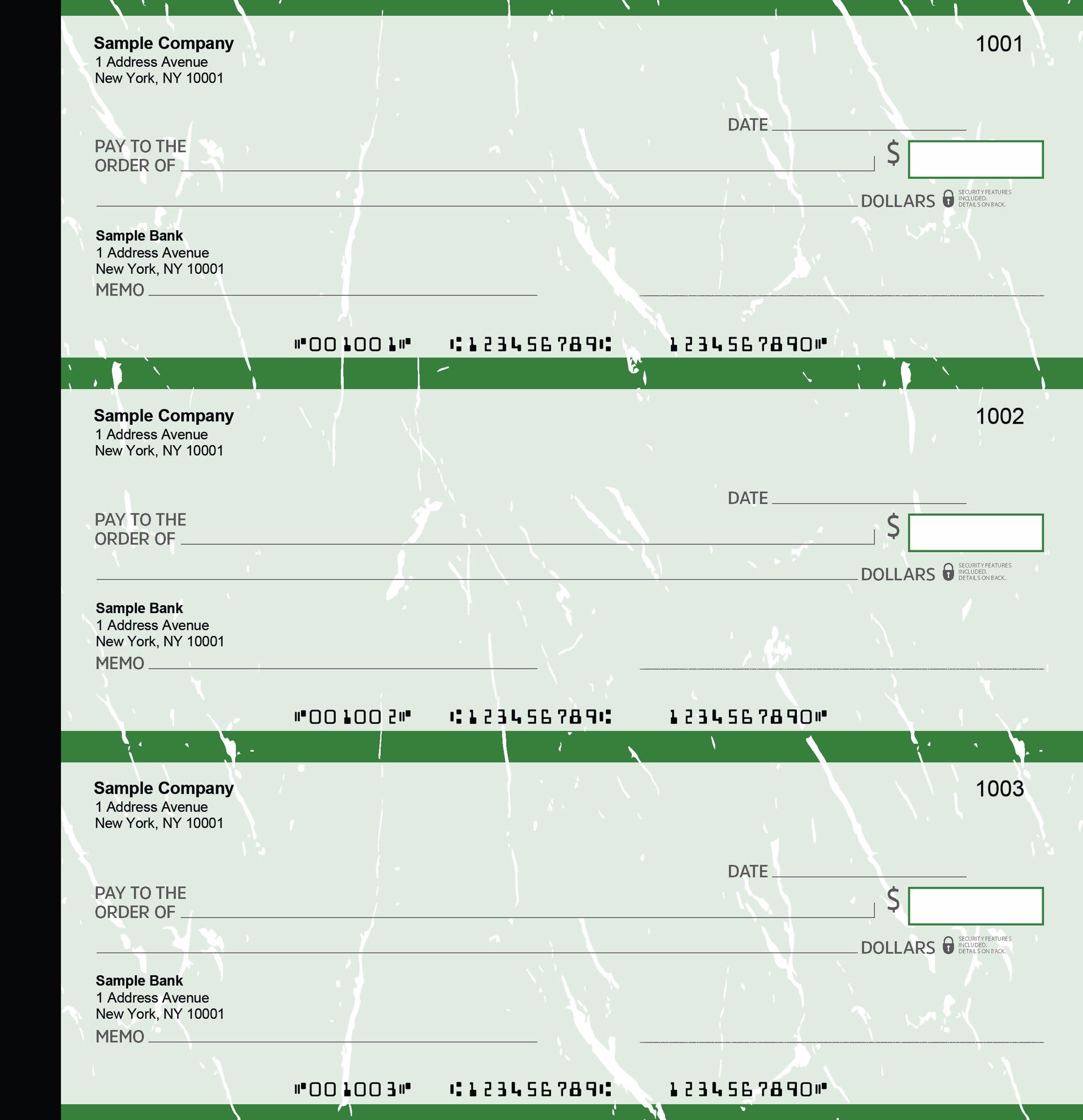
A bound book keeps the stub attached, which matters for payments you may have to trace. See compact three per page manual business checks for that format.
Which voucher goes with which return?
Each return that accepts a mailed payment has its own voucher, and the instruction is always to enclose it rather than attach it. The individual payment voucher is explicit: enclose, but do not staple or attach, your payment.
Not every return has one. There is no federal payment voucher for the corporate income tax return, because corporate payments of that kind are made electronically instead. If you are hunting for a voucher that does not exist, that is usually the reason.
Does the mailing address change if a payment is enclosed?
Yes, and this trips up more filers than any other step. The filing address tables give one address for a return mailed with a payment and a different one for a return mailed without. Read the column heading before you address the envelope.
What can you not pay by check?
Federal tax deposits. This is the hard exception, and almost nothing written for small business says it plainly. The annual withheld income tax return instructions state that you must use electronic funds transfer to make all federal tax deposits.
The corporate return instructions say the same thing twice over. Corporations must use electronic funds transfer to make all federal tax deposits, and the corporation must use electronic funds transfer to make installment payments of estimated tax.
There is also a size limit on a mailed payment. Official guidance states that payments over 10 million dollars must be made by same day wire or by the electronic payment system.
Work out which of your payments are deposits. Payroll tax deposits are the common case, and a business that mails one has not just chosen a slower method, it has used a method the instructions rule out.
Should a tax payment go out on its own item?
Yes, always. One payment, one period, one form. Combining two periods on a single item is how a payment ends up split or misapplied.
The same goes for mixing a tax payment with anything else. A payment that settles a tax bill and a supplier invoice at once has no clean record on either side, and it cannot be traced if a question comes up.
How do you prove you paid on time?
With the envelope, not with the canceled item. Official guidance on estimated taxes states that for a mailed payment the date of the postmark is the date of payment, and the underlying regulation sets the conditions.
That regulation treats the date of the postmark stamped on the envelope as the filing and payment date, provided the item is properly addressed to the agency, officer, or office, and sent with sufficient postage prepaid.
| What to keep | What it proves |
|---|---|
| The mailing receipt | The date you posted it |
| A copy of the voucher | Which period and form the payment was for |
| The check stub | The amount, the date and the account it came from |
| The addressed envelope details | That it went to the right address with postage paid |
Allow processing time. Official guidance asks you to allow two weeks for a check to be received and processed, and notes that using a private delivery service may delay payment processing where a payment voucher is enclosed.
Larger remittances also get handled differently inside the agency, with separate internal procedures triggered at 100,000 dollars and again at 1 million dollars. That is worth knowing if you are mailing a very large payment close to a deadline.
What if it is never cashed or goes to the wrong year?
Both happen, and both have a route. If a payment has not been taken after a reasonable wait, official guidance says that once it has been at least two weeks since you sent the payment you can stop payment and pay again. It adds that if you choose this option, the agency will not charge a dishonored check penalty, and your bank's stop payment fee can be claimed back on the prescribed form.
- Confirm the two weeks have passed before doing anything.
- Place the stop payment and keep the bank's confirmation.
- Pay again, and note which method you used the second time.
- Claim the bank fee on the form provided for it.
- Keep both stubs so the file shows one payment, not two.
What if the payment lands on the wrong period?
Write to the address on the notice, quote both periods, and attach a copy of the item and the voucher. A misapplied payment is an allocation problem rather than a missing payment, and the paperwork you kept is what moves it.
The cause is nearly always the same. Either the form name or the period was missing from the check, or a personal number was used on a business payment. Fixing the habit prevents the correspondence.
Two record areas let you keep one copy with the return and one in the file. See blank checks on the middle for that layout.
What about state business tax?
The pattern repeats, with different wording. One state directs payment to the tax itself rather than to the state, and asks you to write your employer number and the form reference on the check. Another requires payment to its department of revenue, in United States dollars drawn on a domestic bank.
Never assume the federal wording works at state level. Read the state voucher each time, because the payee line is the field states vary most.
Related reading
- Check register covers recording a payment you may need to trace.
- How to write a business check by hand covers the payee line and the amount box.
- Check washing covers protecting a mailed payment.
- How long to keep business checks covers retaining the proof.
What to do next
Make a list of the tax payments your business sends in a year and mark which ones are deposits. Those are the ones that cannot go by check, and most businesses have never separated the two.
Then set the stock up so the record happens by itself. Business checks come with a stub wide enough for a form name and a period, and high security business checks suit the larger payments that travel by post.
About the Author
We hear about this subject in the first week of a quarter, from bookkeepers who have just had a payment credited to the wrong period. The fix is always the same and always small. There was nowhere on the stub to write the form and the period, so nobody did.
The payee wording, the identifying details, the electronic default, the deposit exception and the postmark rule above are drawn from current federal payment guidance, form instructions and regulations, plus two state revenue departments as examples. All of it changes, so check the instruction in front of you on the day.