
- - -
- hours mins seconds
to get your checks by
Tomorrow, Nov. 4th

 0
You have no items in your shopping cart.
Patient Refund Checks: Privacy, Signing and Uncashed Funds
Last updated: November 3, 2026
A credit balance on a patient ledger looks like a bookkeeping job. Then somebody types a treatment description on the memo line, the practice owner signs nothing, and the check sits uncashed for two years. Three different problems, all created by the payment rather than the accounting.
Quick Summary
Patient refund checks need three decisions a practice usually makes by accident. Put only a traceable reference on the memo line, keep the person who posts the credit apart from the person who signs, and treat an uncashed refund as money you are holding for the patient rather than money you have kept.
- No clinical detail on the memo line. Federal privacy guidance asks for reasonable steps to limit information to what the purpose needs.
- A reference number is enough for the patient to recognize the payment and for staff to trace it.
- Split the roles. Whoever posts the credit balance should not also sign the refund.
- Set a limit on stamped signatures, above which a person signs by hand.
- Uncashed is not income. Outstanding checks are reportable unclaimed property in the payee's name.
- Send the notice before reporting. One state manual requires written notice for property valued at fifty dollars or more.
Here is how the three decisions line up against what usually happens instead.
| Decision point | What often happens | Better practice |
|---|---|---|
| Memo line | Procedure or visit description typed in full | Refund reference or account number only |
| Signing | Billing staff prepare and stamp in one pass | Second person approves, stamp limited by policy |
| Uncashed refunds | Written back to income after a year or two | Notice sent, then reported to the state |
| Payer refunds | Claim reference lost on the memo line | Recoupment reference recorded on the stub |
This page is general information about payment process and record keeping. It is not legal, compliance or tax advice, and the privacy and unclaimed property rules that bind your practice depend on your state and your own policies, so treat your compliance officer and your advisers as the authority.
On the stock itself, business checks can be laid out with a stub wide enough to carry a refund reference, which is what keeps clinical detail off the part of the document that travels.
What this guide covers
- Why do practices end up writing refund checks?
- What belongs on the memo line?
- Who should sign a patient refund check?
- Is a signature stamp acceptable?
- What happens to uncashed refund checks?
- How are payer refunds different?
Why do practices end up writing refund checks?
A patient refund check is the payment a practice issues when a patient account holds more money than the patient owes. The credit arrives from ordinary billing timing rather than from error, which is why it recurs in every practice regardless of how carefully the front desk works.
- An estimate collected up front turns out to exceed the allowed amount after adjudication.
- Two payers both pay, and coordination of benefits is settled afterwards.
- A patient pays twice, once at the desk and once from a statement.
- A plan reprocesses a claim and shifts the balance back off the patient.
- A treatment plan changes after a deposit has been taken.
The volume is the point. Because these are routine, the refund becomes a repeated process rather than a one-off decision, and a repeated process is worth getting right once.
What belongs on the memo line?
A reference the patient will recognize and your team can trace, and nothing clinical. Federal guidance on the minimum necessary requirement says covered entities must take reasonable steps to limit the use or disclosure of protected health information to what is needed for the intended purpose, and a refund does not need a diagnosis or a procedure name to work.
Does the standard even apply to a refund to the patient?
Not to the payee line. The same guidance lists disclosures to the individual who is the subject of the information among the situations the minimum necessary standard does not cover, so naming the patient as payee is not the issue.
The care is needed for everything around that name. A mailed document passes through hands that are not the patient's, a window envelope shows whatever sits in the window, and a stub often gets filed or scanned by a third party.
What does a workable memo convention look like?
- Use a refund reference number generated by your practice system.
- Add the account number if patients need it to recognize the payment.
- Put the date of service on the internal copy only, not the mailed document.
- Never type a procedure, diagnosis or body part anywhere on the item.
- Write the convention down so it survives staff turnover.
The same guidance notes that routine and recurring disclosures may follow standard protocols, and that individual review of each disclosure is not required. A written memo line convention is exactly that kind of protocol.
Who should sign a patient refund check?
Someone other than the person who posted the credit balance. A refund is the one payment in a practice where the same software, the same person and the same afternoon can create the reason to pay and the payment itself, which is why a fictitious refund is a recurring form of practice fraud.
Separating the two roles costs nothing. Our guide to check signing policy covers how to write the split into a policy, and check register covers the record that lets an owner spot a refund that nobody can explain.
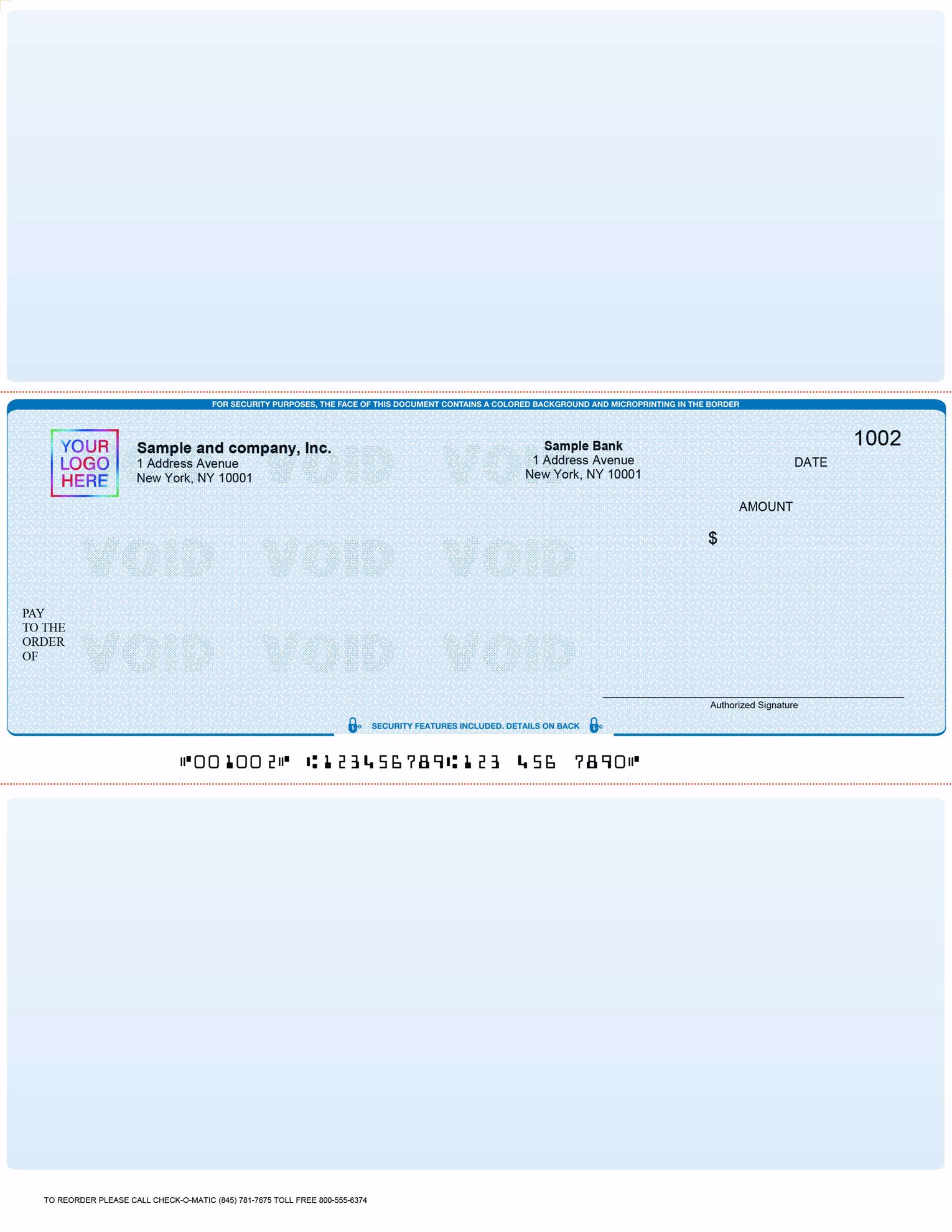
A middle position layout gives two stubs, one for the patient record and one for the practice file. See business checks in the middle for the format.
Is a signature stamp acceptable?
A stamp or facsimile signature is widely accepted on business payments and plenty of practices rely on one, particularly where the signer is in clinic all day. It is a convenience, so the controls around it have to replace the judgment it removes.
- Store the stamp away from the check stock, under a separate lock and a named holder.
- Keep the holder out of payment preparation, so one person cannot complete a payment alone.
- Set a dollar ceiling above which a manual signature is required.
- Log each use against the check number and the approver.
- Review the log monthly against the register rather than at year end.
If you use one, custom signature stamps are made from the signature you supply, and the policy above is what makes that convenience safe.
Where payments are large, the stock matters too. High security business checks add tamper resistance to items that leave the building, and blank check security features explains what each printed feature is for.
What happens to uncashed refund checks?
They stay the patient's money. State unclaimed property law treats an outstanding check as property held for the payee, so the practice is a holder rather than an owner, and writing the amount back to income is the mistake these laws exist to prevent.
One state reporting manual gives a clear picture of what a holder is expected to do. It says the property to identify includes any type of outstanding check, and it directs holders to review aged checks on outstanding check lists along with stopped or voided checks that were never reissued.
What does the holder process look like?
- Keep an outstanding check list that someone actually reviews on a schedule.
- Try to reach the patient first, since a reissued refund never becomes a filing.
- Send the written due diligence notice to the last known address. That manual sets the threshold at property valued at fifty dollars or more.
- Send it inside the notice window, described there as no more than 180 days and no less than 60 days before the report is filed.
- Report and remit what stays unclaimed after the dormancy period.
That manual uses a general dormancy period of three years, with aggregate uncashed checks carried under a three year code, while other instrument types differ: one year for uncashed state warrants, seven years for non-bank money orders and fifteen years for traveler's checks.
Treat those numbers as an illustration, not your rule. Dormancy periods, notice thresholds and filing dates are set state by state, so the administrator in your state governs what your practice has to do and when.
Does a stale date end the obligation?
No. A bank may decline an item that has aged past the point its own rules allow, but a refused check does not cancel the money owed. Our guide to how long a business check is good for covers the banking side, and the obligation outlives it either way.
How are payer refunds different?
The controls are the same and the paperwork is not. A payer recovering an overpayment usually wants its own recoupment or claim reference quoted back, and it will apply the money to the wrong account if that reference travels only on the memo line and gets separated from the item.
- Put the payer reference on the stub, where it stays with your copy.
- List the claim numbers a single refund covers rather than sending one lump.
- Keep the request letter with the stub copy in the same file.
- Verify any change of remit to address by calling a number you already held.
That last point is not paranoia about payers. A request to send money somewhere new is the most ordinary looking fraud a finance office sees, and a call to a number you already had is the whole defense.
Related reading
- Check signing policy covers writing the approval split into your rules.
- Check register covers the record that makes an unexplained refund visible.
- How long is a business check good for covers stale dating and reissue.
- Check washing covers protecting items that go in the mail.
What to do next
Pull your outstanding check list this week and read the memo lines on the last twenty refunds you issued. Those two documents will tell you whether you have a privacy habit to fix, a signing gap to close, or a holder filing to prepare, and usually it is more than one.
Then set the stock up so the right thing is easy. Business checks are printed to the layout and signature line arrangement you specify, and custom signature stamps are made to match the signer your policy names.
About the Author
Our customers include medical and dental practices in every state, and refunds are the payment they ask about most. Practice managers ask us for the same two things more than anything else: a wider stub, and a second signature line. Both requests usually arrive after an audit rather than before one.
The privacy points here follow federal guidance on the minimum necessary requirement, and the holder duties follow a state unclaimed property reporting manual used as a worked example. Your state and your compliance officer set what applies to you.