
- - -
- hours mins seconds
to get your checks by
Tomorrow, Nov. 24th

 0
You have no items in your shopping cart.
Parts of a Check: How to Read Every Field on a Check
Last updated: November 23, 2026
A check looks simple until a bank asks you for the routing number, a vendor asks why your check number sits on the left, or a teller rejects an item because the words and figures disagree. Every one of those problems comes down to knowing what each part of a check does.
This guide walks through every field on the front, the three number groups along the bottom, and the endorsement area on the back, with the differences between a personal check and a business check laid out side by side.
Quick Summary
The parts of a check fall into three groups: details printed before you write it (your name and address, the bank name, the check number and the fractional routing number), fields the writer fills in (date, payee, amount in figures, amount in words, memo and signature), and the magnetic MICR line along the bottom that carries the routing number, account number and check number. The back holds the endorsement.
- The routing number is always nine digits. It identifies the bank, and its first two digits normally fall between 01 and 12 or between 21 and 32.
- The account number is the second group on most personal checks. It can run up to 17 characters, so it is often longer than the routing number.
- Business checks often put the check number first. Many business layouts print it on the left of the MICR line, which is where most readers least expect it.
- Words beat figures. If the written amount and the numeric amount disagree, the words control under the Uniform Commercial Code.
- Only the bottom line needs magnetic ink. The date, payee and amount can be written in ordinary ink.
- The check number appears twice. On a genuine check the number in the top corner matches the number encoded at the bottom.
Here is every part of a check at a glance, in the order a reader usually scans it.
| # | Part | Where it sits | Who adds it | What it does |
|---|---|---|---|---|
| 1 | Name and address | Top left | Printer | Names the account holder who is paying |
| 2 | Check number | Top right, and again in the MICR line | Printer | Gives each check a unique serial for records |
| 3 | Fractional routing number | Near the check number | Printer | Backup form of the bank's routing number |
| 4 | Date line | Top right | Writer | Shows when the check was written |
| 5 | Pay to the order of | Center left | Writer | Names the payee who may collect the money |
| 6 | Amount box | Right of the payee line | Writer | The amount in figures |
| 7 | Amount line | Below the payee line | Writer | The amount in words, which controls |
| 8 | Bank name | Middle or lower left | Printer | Names the bank that holds the account |
| 9 | Memo line | Lower left | Writer | Notes the purpose, such as an invoice number |
| 10 | Signature line | Lower right | Authorized signer | Authorizes the bank to pay |
| 11 | MICR line | Bottom edge | Printer | Routing, account and check numbers in magnetic ink |
| 12 | Endorsement area | Back, top third | Payee | Where the payee signs to deposit or transfer it |
This page is general information about how checks are laid out and read. It is not legal or banking advice. Your account agreement and state law govern, so confirm anything about a specific item with your bank.
If you write checks for a company, business checks printed with your exact account details are what make every one of these fields read correctly at the bank.
What this guide covers
- What are the parts on the front of a check?
- How do you read the numbers at the bottom of a check?
- Why is the check number on the left on business checks?
- Who is the payee, drawer and drawee on a check?
- What is the fractional routing number?
- What if the amount in words and numbers do not match?
- What does the date line control?
- What is on the back of a check?
- What should you check before you accept a check?
- Related reading
- What to do next
What are the parts on the front of a check?
The front of a check holds two kinds of fields: the details the check printer puts on before the check ever reaches you, and the blanks you fill in each time you write one. Knowing which is which helps you spot a check that has been tampered with, because the printed parts should never look handwritten.
Which parts are printed on the check before you write it?
The printed parts identify who is paying and from where. A standard check carries these preprinted details:
- Account holder name and address. On a business check this is the legal or registered business name, which is the name payees and banks match against.
- Bank name. The financial institution that holds the account and will pay the check.
- Check number. A serial number in the top right corner that also appears in the MICR line.
- Fractional routing number. A small fraction near the check number, covered in its own section below.
- MICR line. The row of magnetic characters along the bottom edge.
Business checks often add a logo, a second signature line, and a stub or voucher area for recording the payment. The types of business checks guide shows how each layout places those extras.
Which parts do you fill in when you write a check?
The writer completes six fields, and each one has a job:
- Date. The day you write the check.
- Pay to the order of. The exact name of the person or business being paid.
- Amount box. The amount in figures, written close to the dollar sign.
- Amount line. The same amount in words, with cents as a fraction over 100, followed by a line through the empty space.
- Memo. Optional, but useful for an invoice or account number.
- Signature. The authorized signer's signature, which is what makes the check payable.
For the full writing routine, including how to fill dead space so nothing can be added, see how to write a business check by hand. The signature line on a check guide covers who can sign and when two signatures are needed.
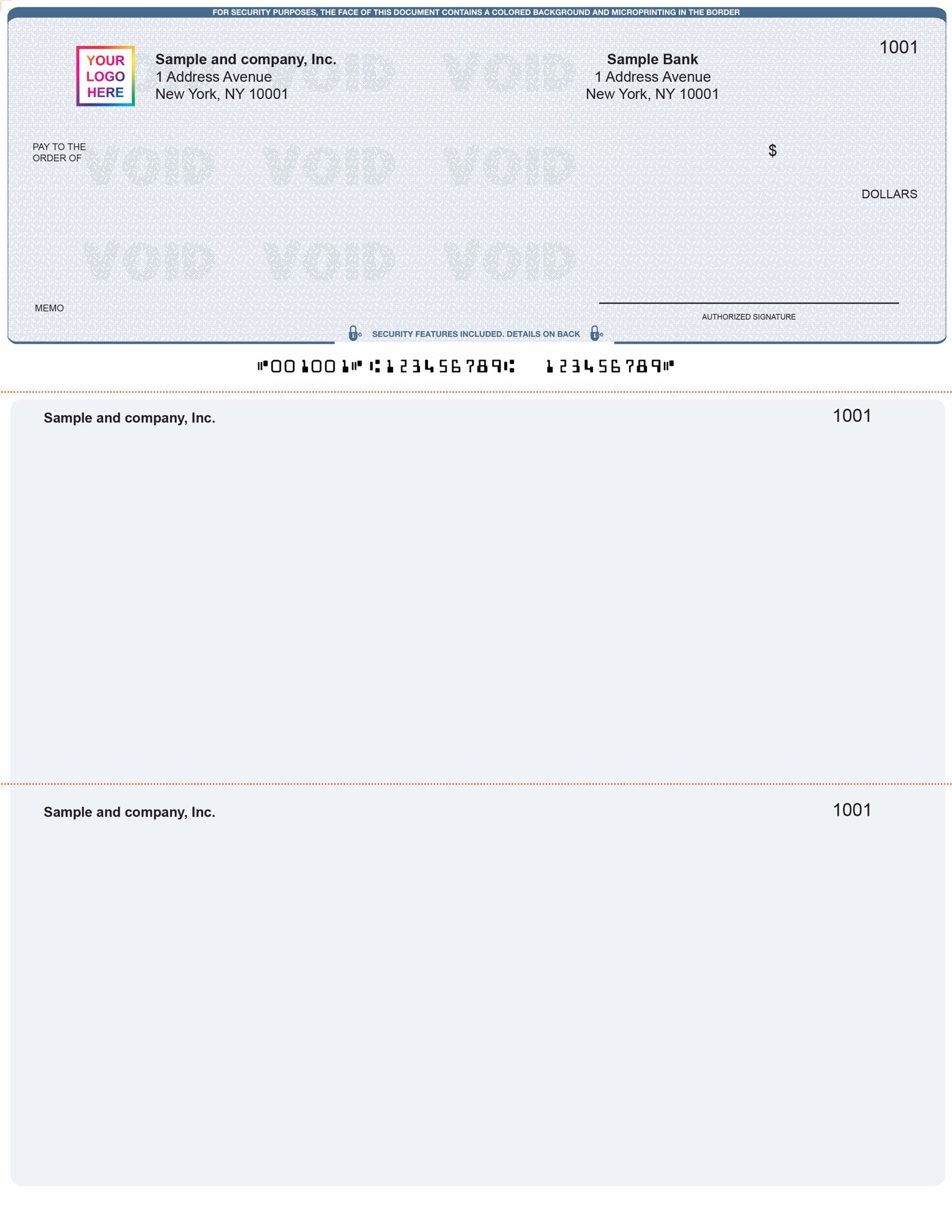
A check on top business layout. The check number prints in the top right corner and again at the left end of the MICR line, and the two stubs below keep a record of each payment.
How do you read the numbers at the bottom of a check?
The numbers at the bottom of a check are the MICR line, short for magnetic ink character recognition. It holds three groups: the nine digit routing number, the account number, and the check number. Banks read this line by machine, which is why it uses magnetic ink and a special font, and why it must sit in a fixed position on the paper.
The order of the three groups is not the same on every check, so use these rules to tell them apart.
| Number | How to recognize it | Typical length | Common mistake |
|---|---|---|---|
| Routing number | Sits between two matching transit symbols and starts with 01 to 12 or 21 to 32 | Always 9 digits | Giving the account number instead |
| Account number | Usually right after the routing number, ending with an on-us symbol | Up to 17 characters | Including the check number with it |
| Check number | Matches the number printed in the top right corner | Matches the top corner number | Assuming it is always last |
Which number is the routing number?
The routing number is the nine digit group framed by two identical transit symbols. It identifies the bank, not your account. The American Bankers Association describes three parts inside it: a four digit Federal Reserve routing symbol, a four digit institution identifier, and a final check digit that lets machines catch typing errors.
The first two digits are a quick sanity check. Banks use 01 through 12, and some thrifts and credit unions use 21 through 32. A government check starts with 00.
If someone reads you a "routing number" that starts with 45, it is not a routing number. The deeper mechanics are in our guide to the MICR line on a check.
Which number is the account number?
The account number identifies your specific account at that bank. On most personal checks it follows the routing number. IRS instructions for direct deposit note that account numbers can be up to 17 characters long and that the routing and account numbers may sit in different places on different checks, which is why you should not assume position alone tells you which is which.
Where is the check number on a check?
The check number appears twice: once in the top right corner and once in the MICR line. On a personal check the encoded copy usually comes last, after the account number. On many business checks it comes first. When a form asks for your account number, leave the check number out, a point the IRS makes in its own direct deposit instructions.
Why is the check number on the left on business checks?
Business checks are wider than wallet style personal checks, and many business layouts use that extra room for an auxiliary on-us field at the far left of the MICR line. The check number goes there, bracketed by on-us symbols, so the routing and account numbers stay in their standard positions while the check number gets more digits.
That is why a business owner reading a personal check guide often gets confused. The popular advice that "the check number is the last group" is true for many personal checks and wrong for many business ones. Bank specifications for business checks allow longer check numbers in that left hand field, which suits companies that write thousands of checks a year.
Here is how the two formats compare part by part.
| Part | Personal check | Business check |
|---|---|---|
| Size and format | Wallet size, usually in a checkbook | Wider, often 3 per page or one check per sheet with stubs |
| MICR order | Routing, account, then check number | Often check number first, then routing and account |
| Check number length | Short | Can be longer, using the auxiliary field |
| Name line | Individual or joint names | Registered business name, sometimes with a logo |
| Signature lines | One | One or two, depending on company policy |
| Record keeping | Register or duplicate copy | Voucher stubs or a software register |
If you are choosing a format, the business checks vs personal checks guide covers when a company needs the business version.
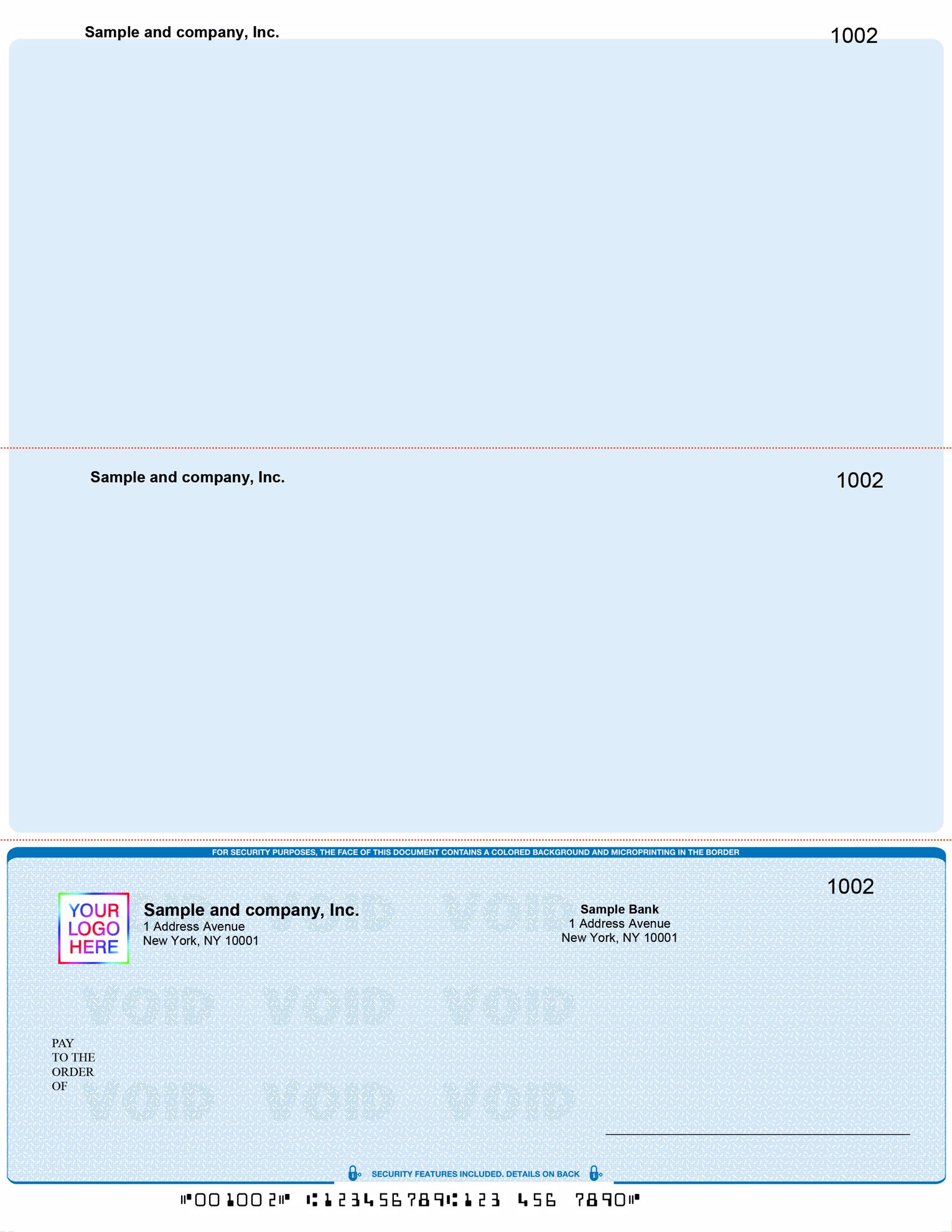
A check on bottom layout. The MICR line always runs along the bottom edge of the check itself, wherever the check sits on the sheet, so stubs never interfere with the bank's reader.
Who is the payee, drawer and drawee on a check?
Every check involves three parties. The drawer is the person or business writing the check and owning the account. The payee is the person or business named on the "pay to the order of" line. The drawee is the bank that holds the drawer's account and is being ordered to pay.
- Drawer (also called the maker or payer). Signs the check and is responsible if it bounces.
- Payee. The only party entitled to collect, unless the payee endorses it to someone else.
- Drawee. The paying bank, named on the front and identified by the routing number.
The payee name matters more than people expect. A check payable to a business is generally deposited to an account in that business name, which is why how to cash a business check spends so long on the payee line.
What is the fractional routing number?
The fractional routing number is a small fraction, often printed near the check number, that carries the same bank identification as the nine digit routing number in a different form. Federal Reserve rules describe the routing number as appearing in two forms: the fraction, usually in the upper right corner, and the nine digit number in magnetic ink along the bottom.
It exists as a backup. If the MICR line is damaged and a machine cannot read it, a person can still identify the paying bank from the fraction. Most people never need to read it, and you should not give it to anyone who asks for your routing number. Use the nine digit number from the MICR line instead.
What if the amount in words and numbers do not match?
When the written amount and the numeric amount on a check disagree, the words control. Section 3-114 of the Uniform Commercial Code says words prevail over numbers, and handwritten terms prevail over printed ones. The Consumer Financial Protection Bureau confirms a check like this is still valid and is paid for the amount in words.
That rule is why the amount line deserves care. A few habits keep both amounts aligned:
- Start the figures right against the dollar sign so no digit can be added in front.
- Write cents as a fraction over 100, for example 45/100.
- Draw a line through unused space after the written amount.
- Re-read both amounts before signing. A mismatch delays payment even though the check is technically valid.
What does the date line control?
The date tells the bank when the check was written, and it affects how long the check stays current. Under the Uniform Commercial Code, a bank has no duty to pay an ordinary check presented more than six months after its date, though it may still choose to pay in good faith.
A future date does not hold a check back on its own. Federal banking guidance notes a bank may pay a postdated check early unless you have given it proper notice. Our guides on postdated checks and how long a business check is good for cover both situations in detail.
What is on the back of a check?
The back of a check holds the endorsement area, a band across the top third where the payee signs before depositing or cashing it. Below it is space the banks use to print their own processing marks, so endorsements should stay inside the marked area.
- Endorsement lines. Where the payee signs, often with "For Deposit Only" and an account number.
- Mobile deposit box. Some checks include a box for the wording banking apps ask for.
- Security notice. Many checks list the security features printed on the paper.
The wording to use is covered in how to endorse a check. Offices that receive a lot of checks often use an endorsement stamp so every item is endorsed the same way.
What should you check before you accept a check?
A quick read of the parts of a check catches most problems before you deposit it. Run through these points, in this order:
- Payee. Your name or business name is spelled the way your bank account shows it.
- Amounts. The words and figures agree, and neither shows signs of alteration.
- Date. It is not more than six months old and not set in the future.
- Signature. It is present, and on a business check it looks like a real signer's signature.
- Check numbers. The number in the top corner matches the number in the MICR line.
- Routing number. It is nine digits and starts with 01 to 12 or 21 to 32.
Altered amounts and changed payee names are the hallmark of check washing, so anything that looks rewritten deserves a call to the issuer before deposit.
Related reading
- MICR line on a check goes deeper on the routing number, symbols and magnetic ink.
- Sample blank check template shows standard check dimensions for layout work.
- What is a voided check explains how to void one safely for direct deposit forms.
- Signature line on a check covers signers, stamps and two signature rules.
What to do next
If you are reading a check you received, the six point routine above is enough for almost every item. If something does not match, call the person or business that wrote it before you deposit it.
If you are writing checks for a company, the printed parts are where accuracy starts. Computer checks carry your name, bank details and MICR line exactly as your bank expects, and manual business checks do the same for handwritten payments. Orders placed before the daily cutoff are produced the same day.
About the Author
Checks Next Day prints business and personal checks for U.S. account holders and ships them the next business day. Every order is proofed against the customer's routing and account details, so questions about which number goes where reach us every day.
The rules described here were checked against published federal banking guidance, the Uniform Commercial Code sections on amounts and dates, and banking industry routing number policy. Bank practices differ, so confirm anything about a specific item with your own bank.