
- - -
- hours mins seconds
to get your checks by
Tomorrow, Oct. 23rd

 0
You have no items in your shopping cart.
Business Checks for Nonprofits and Churches
Last updated: October 22, 2026
Every guide to nonprofit disbursement controls stops at policy. None of them mention that the check itself has to carry something for those controls to hold up when a reviewer tests them, which is the gap this page fills.
Quick Summary
Business checks for nonprofits and churches are ordinary business checks used under tighter controls. What changes is not the paper, it is the requirement that every payment be traceable, approved before it was prepared, and reviewed by someone who did not prepare it.
- Pre-numbered checks are the baseline. Federal guidance for grant funded programs puts every disbursement other than petty cash onto a pre-numbered check.
- Two signature lines make the expectation visible. Two signatures is described as a basic internal control, usually applied above a threshold your board sets.
- The bookkeeper should not be the only signer. The control exists to stop one person holding sole authority to write checks.
- Never pre-sign. Guidance on disbursement controls says checks should not be pre-signed, and that written policy should prohibit it.
- Voided checks stay in the file, they do not go in the trash. Mark the check void, cut out or black out the signature line so it cannot be reused, then file it with the voucher it belongs to.
- The stub is where fund coding belongs. A voucher stub survives into the audit file. A memo line is a label.
The table below maps the controls the sector expects to the feature the check has to carry. Each row is explained further down.
| Control the sector expects | What the check has to carry |
|---|---|
| Every disbursement traceable | A printed sequential number, issued and logged in order |
| Second review of significant payments | Two signature lines printed on the face |
| Approval recorded before preparation | A voucher stub with room for the approval reference |
| Restricted funds tracked | Stub space for fund name and budget line |
| Independent reconciliation | A register or duplicate record the reviewer can hold |
| Blank stock access limited | Secured stock, stored locked, with the number range logged |
This page is general information about check handling and disbursement controls, not legal, accounting or tax advice. Your own bylaws, funder agreements and auditor requirements govern, so confirm specifics with your accountant and your board.
If you are setting a new account up, business checks come in every format described here and are produced the same day.
What this guide covers
- What makes nonprofit check handling different?
- Which controls do auditors and funders expect?
- Which check features support each control?
- Which check format should you order?
- How should a church handle checks with volunteer help?
- How should a nonprofit handle payroll checks?
- How do you record a restricted fund on a check?
- What should you do with voided checks?
- How do you keep blank check stock secure?
What makes nonprofit check handling different?
The money belongs to a mission rather than an owner, so someone outside the organization eventually tests how it was spent. A small company can run on trust and survive. A nonprofit is answerable to a board, often to funders, and sometimes to an auditor who will sample payments and ask to see the trail.
That changes what a check has to do. It is no longer just an instruction to the bank. It is a record.
Who actually signs the checks?
Someone other than the person who keeps the books, and not that person acting alone. The sector guidance is consistent on the underlying principle: the point of the control is to stop one person holding sole authority to write checks.
- Name roles, not only people. A policy written around job titles survives a change of treasurer.
- Keep signers to the minimum practical. Disbursement guidance asks for exactly that, with signing kept to people senior enough to carry it.
- Separate preparation from signing. Whoever prepares the payment should not be the person who authorizes it.
- Put the bank statement in different hands. A second person besides the bookkeeper should see statements.
Our guide to who signs a business check covers how signing authority is set up at the bank, which is a separate question from who your policy allows.
Why is segregation of duties harder in a small nonprofit?
Because the model assumes four pairs of hands and many organizations have one. Disbursement guidance defines segregation as never letting a single person carry one transaction the whole way through, splitting the authorizing, the signing, the recording and the reconciling between different people.
The same guidance offers the workable compromise for a single staff organization: the staff member signs, while a board officer such as the treasurer looks over disbursements, statements and canceled checks every month.
That is the pattern worth copying. When you cannot split the doing, split the reviewing.
Which controls do auditors and funders expect?
A short list comes up repeatedly across nonprofit governance guidance and federal grant guidance. None of it is exotic, and most of it costs nothing beyond the discipline to follow it.
- Written authorization rules. Who may approve a payment, and what counts as significant enough to need more approval.
- Documentation for every disbursement. An invoice or receipt plus a disbursement voucher, not a note from memory.
- A pre-numbered check for every disbursement apart from petty cash.
- Independent reconciliation. Done by someone outside the authorization and signing functions.
- No checks payable to cash, and no pre-signing. Both stated as policy level prohibitions.
- Limited access to blank checks. Who can reach the stock is treated as a control in its own right.
- Periodic vendor list review by someone objective, to catch payees nobody can explain.
Why must disbursements use pre-numbered checks?
Because the number is what makes a payment provable. Federal guidance for grant funded programs requires a pre-numbered check for every disbursement apart from petty cash, and the reason is simple: an unbroken sequence lets a reviewer demonstrate that nothing was issued outside the records.
A gap in that sequence is not a small untidiness. It is a question you have to answer, and the honest answers are narrow: it was voided and filed, it was spoiled in the printer, or it is unaccounted for.
- Record the number range when stock arrives. This takes seconds and makes every later check possible.
- Issue in order. Skipping around destroys the one property the sequence gives you.
- Reconcile the sequence, not just the balance. A missing number shows up nowhere else.
A check register is where that sequence lives between the stock cupboard and the bank statement.
What should your check policy prohibit outright?
Short rules that need no judgment are the ones that hold under pressure. Guidance on disbursement controls names two specifically, and practice adds the rest.
- Never draw a check payable to cash. It removes the payee, and the payee is the record.
- Never pre-sign. A signed blank is a negotiable instrument with no review attached to it.
- Never sign without the supporting document. Signing on trust works until it does not.
- Never leave signed checks unattended between signing and sending.
- Never let the preparer also post the entry and reconcile. That is the whole loop in one pair of hands.
Our guide to a written check signing policy covers how to put these in a document your board can adopt.
Which check features support each control?
This is the half the sector guidance leaves out. A control written in a policy still has to be executable on the day, and several of them depend on what is printed on the document in front of the signer.
| Feature | Control it makes possible | What happens without it |
|---|---|---|
| Printed sequential number | Traceability and gap detection | No way to prove nothing was issued off book |
| Two signature lines | Second review above your threshold | The rule lives only in a policy nobody sees at signing |
| Voucher stub | Approval reference and fund coding travel with the payment | Coding is reconstructed later from memory |
| Duplicate or carbon record | An immediate record where checks are handwritten | The only record is whatever the writer remembered to note |
| Security stock | Alteration and copying become visible | A changed check looks exactly like a clean one |
| Organization name printed | No commingling with a personal account | Payments cannot be told apart at a glance |
The security side is explained feature by feature in our guide to blank check security features, and the formats that carry them are covered under high security business checks.
Which check format should you order?
Pick the format by how your checks get written, not by size of budget. The two things that decide it are whether payments come out of accounting software and whether a volunteer might be the one holding the pen.
| Your situation | Format that fits | Why |
|---|---|---|
| Payments run from accounting software | Check on top with a voucher stub | The stub prints the coding, so the record is made at the same moment as the payment |
| Checks written by hand in the office | Manual book with a duplicate record | A copy exists without anyone remembering to write one |
| Mixed, software plus occasional hand written | Multi purpose format | One stock covers both habits without a second order |
| Separate payroll run | Payroll format on its own sequence | Keeps pay detail off the accounts payable record |
| High volume, low detail | Three per page | Volume without a voucher, so coding has to live in the register |
When does a voucher check earn its place?
Whenever a payment has to be explained to somebody later, which in a nonprofit is most of them. The voucher stub carries the invoice reference, the fund and the approval alongside the amount, so the explanation is attached rather than reconstructed.
That is also the format most accounting software expects, which matters because the layout your software prints to has to match the stock you bought.
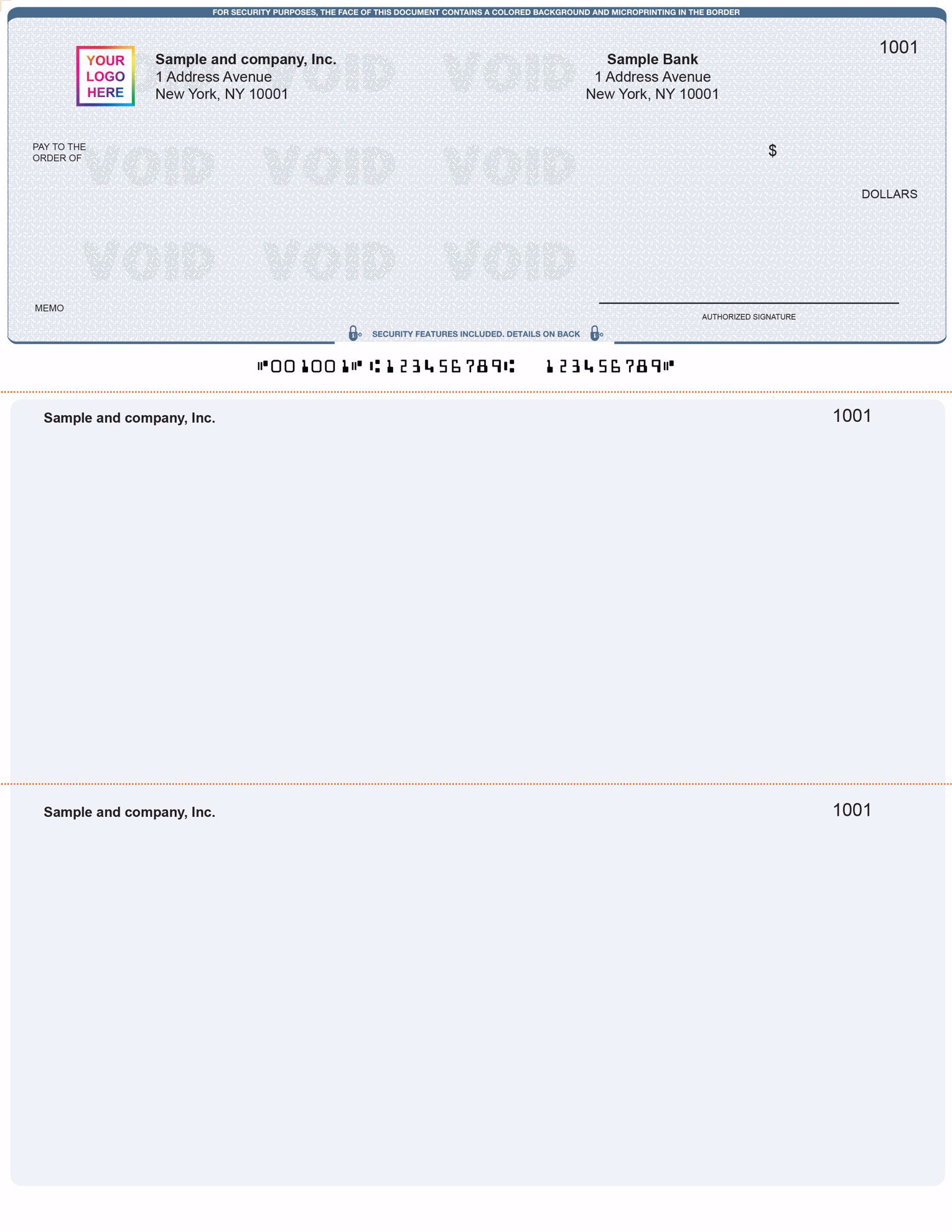
Our computer checks range covers all four positions, and types of business checks explains what each layout is for.
When is a manual check book the better fit?
When checks get written by whoever is in the building. A manual book keeps the stock, the writing surface and the record in one object, which is far harder to lose track of than loose sheets and a spreadsheet.
It also removes a failure mode that catches small organizations: nobody has to remember to open the accounting file before writing a check.
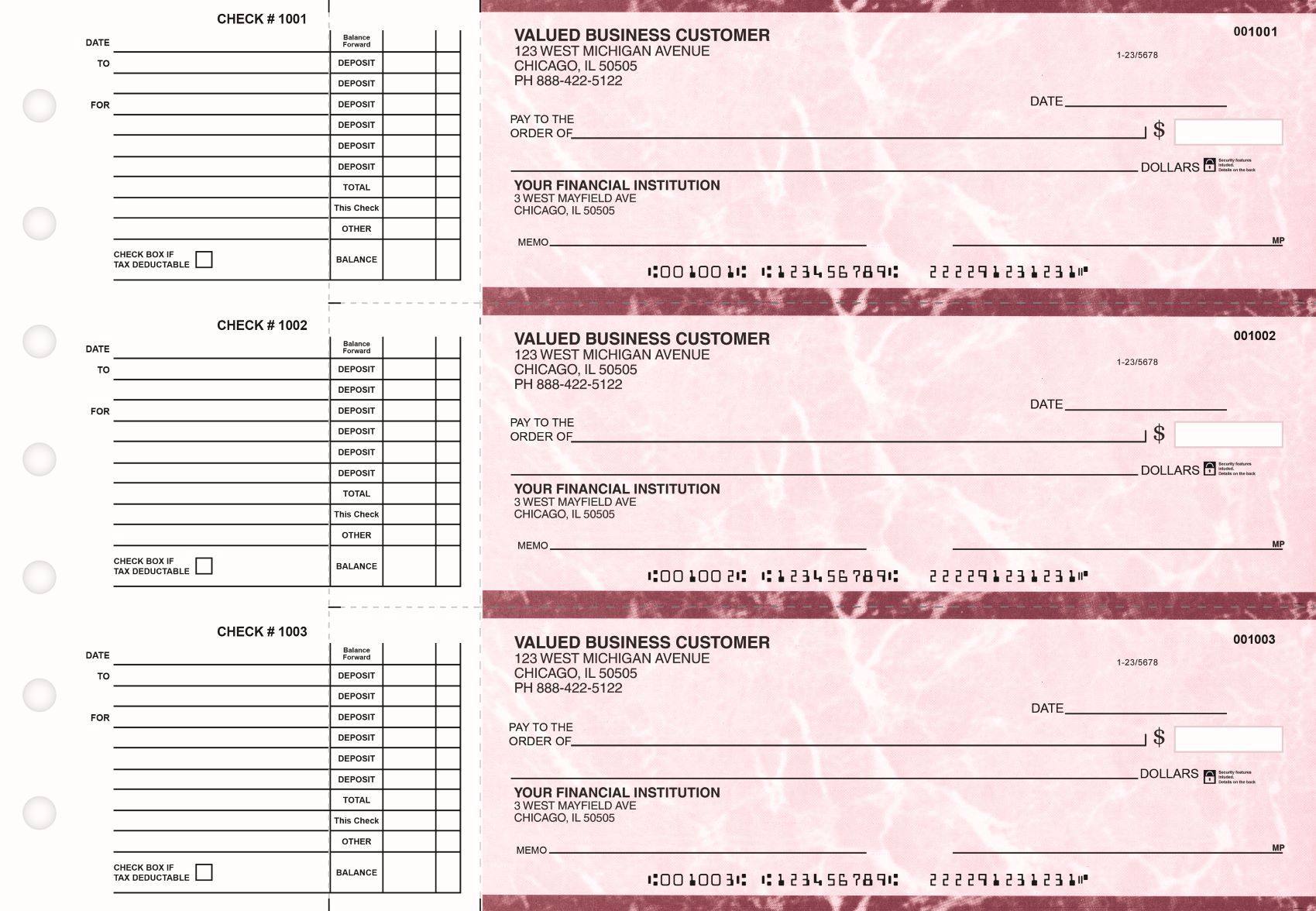
See manual business checks for the formats, or multi purpose business checks if you write some by hand and print the rest.
How should a church handle checks with volunteer help?
Let volunteers take part, but never let one person carry a payment from approval to reconciliation. Volunteer involvement is not the risk. A single unreviewed pair of hands is the risk, paid or not.
- Split preparation from signing. A volunteer can prepare while a named officer signs.
- Give the statement to a third person. Guidance is explicit that someone besides the bookkeeper should see it.
- Separate receiving from depositing. The person logging incoming checks should not be the person banking them.
- Rotate, and record the rotation. A rota is only a control if you can show who held what and when.
- Keep stock locked, not shared. Access to blank checks is itself a control.
One habit does more than all of these. Have whoever opens the bank statement be the person who does not prepare payments, and the rest of the structure matters less.
How should a nonprofit handle payroll checks?
Run payroll on its own stock and its own sequence. Guidance on nonprofit controls is specific that the person who prepares the payroll should not also distribute or hold custody of the payroll checks.
A separate sequence makes that split visible. When payroll and accounts payable share a number range, a reviewer cannot tell at a glance which process a given check came out of.
- Keep pay detail off the accounts payable stub. Different readers, different confidentiality.
- Fund the account before the run. Payday has no slack built into it.
- Do not let the preparer hand them out. That is the named control.
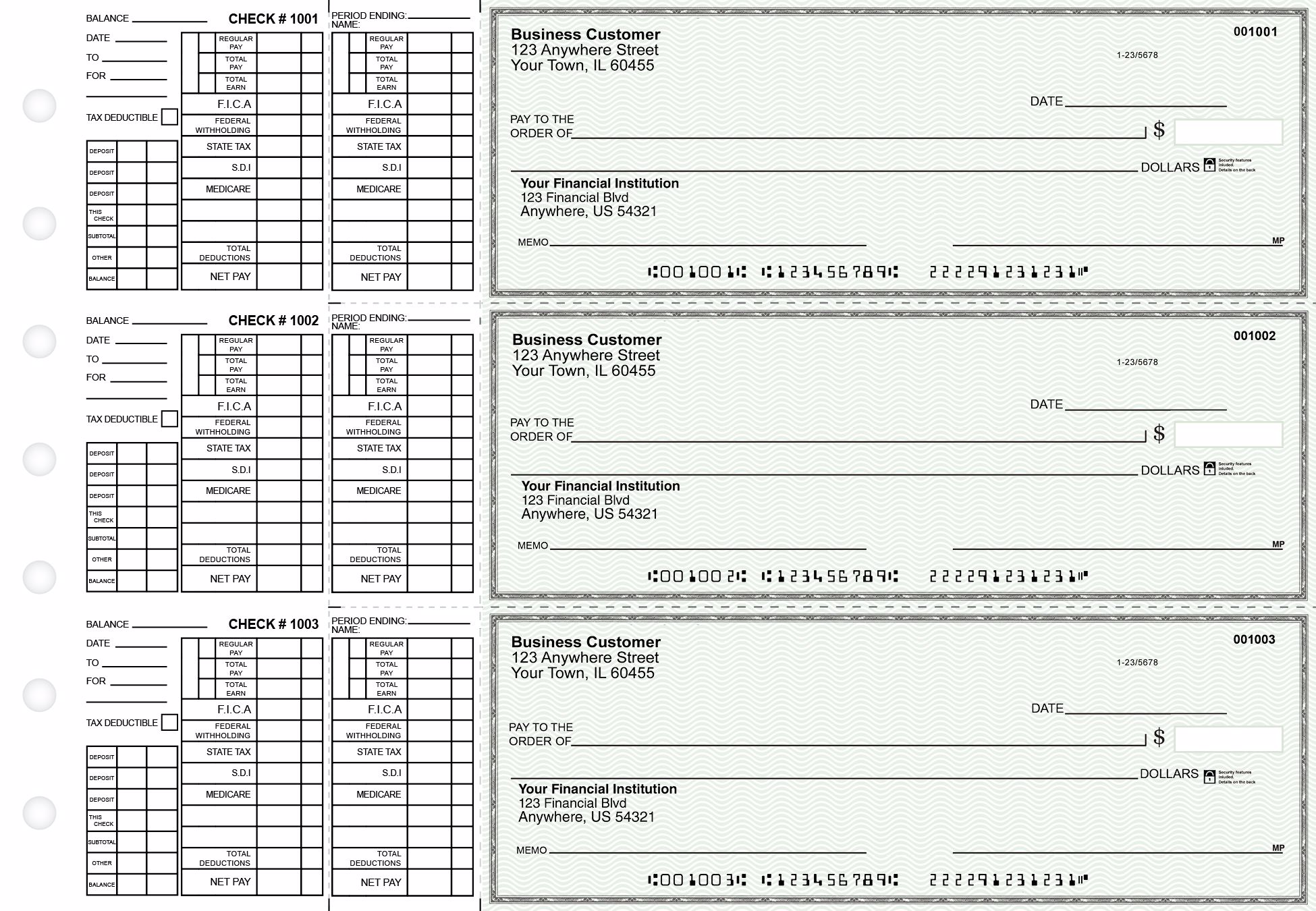
Payroll business checks are a separate format for exactly this reason, and making payroll checks covers running the cycle itself.
How do you record a restricted fund on a check?
Put it on the stub, not the memo line. Restricted funds are the thing a funder or auditor is most likely to test, and the memo line is the weakest place in the whole document to record anything.
A memo is written by whoever prepared the check. It reads as evidence and it is not. A voucher stub has room for the fund name, the budget line and the approval reference, and it stays attached to the record that gets tested.
- Fund name in full. Abbreviations stop meaning anything once the person who invented them leaves.
- Budget line or grant reference. This is the field that answers the funder's question.
- Approval reference. Point at the minute, form or initialed invoice that authorized it.
- Never split a restricted payment across funds on one stub without showing the split.
What should you do with voided checks?
Keep them. Federal guidance for grant funded programs asks that a void be defaced and then filed rather than thrown away, with the signature area the part you deface.
The reason is the sequence. A void that was thrown away and a check that is genuinely unaccounted for look identical in your records, and only one of them is innocent.
- Write VOID clearly across the face so it cannot be presented.
- Deface the signature area rather than the whole document.
- File it in number order with the rest of the sequence.
- Note the void in the register against its number.
- Never tear it up. That converts a clean record into an open question.
Our guide to what is a voided check covers the mechanics and the other reasons a void gets requested.
How do you keep blank check stock secure?
Treat blank stock as cash, because in practical terms it is. Nonprofit guidance raises access to blank checks as a question in its own right, alongside who may sign them, and in a shared office that question has a different answer every day unless someone fixes it.
- Locked, and not in the same drawer as the signature stamp.
- One named custodian, with a deputy, rather than a shared key.
- Log the number range on arrival, before the box goes away.
- Issue in sequence and record what was taken out.
- Count what is left periodically. A surprise count is a recommended nonprofit control.
Writing checks by hand has its own discipline, covered in how to write a business check by hand.
Related reading
- Check signing policy covers what to put in the written document your board adopts.
- Who signs a business check covers signing authority at the bank.
- Check register covers the record that makes sequence review possible.
- Types of business checks covers every format in one place.
What to do next
Start with two things that cost nothing. Record the check number range the next time stock arrives, and move the bank statement into the hands of someone who does not prepare payments.
Then make the document carry its share. Business checks are available in every format described here, with two signature lines where your policy needs them, and high security business checks add tamper resistance on the same stock. Both are produced the same day and delivered the next.
About the Author
The Checks Next Day team prints and ships business checks for U.S. organizations every business day, including churches, charities and grant funded nonprofits, with same day production and next day delivery. Questions about signature lines, separate payroll sequences and what a stub needs to show come up constantly at order time, and the guidance here reflects those conversations alongside published nonprofit and federal grant control guidance. Your bylaws, funder agreements and auditor requirements govern your organization, so confirm specifics with your accountant and your board.