
- - -
- hours mins seconds
to get your checks by
Tomorrow, Oct. 16th

 0
0 You have no items in your shopping cart.
How Long to Keep Business Checks and Bank Records
It is a quiet Friday, the filing season is over, and a filing cabinet full of old checks is taking up space. Shredding it feels tempting, but a missing check can leave you unable to prove an expense.
This guide explains how long to keep business checks and bank records. You will see the retention periods the IRS lists, which check records matter most, when a scan is enough, and how to organize it all so you can find any payment in minutes.
Quick Summary
A business should generally keep checks and bank records for at least three years, counted from the return they support, and longer in specific cases. Employment tax records should be kept for at least four years. This is general information, so confirm your own situation with an accountant.
- Three years is the usual starting point. The IRS says to keep records until the period of limitations for the return runs out, which is generally three years.
- Some cases need six or seven years. Six years applies if you leave out more than 25% of the gross income on your return, and seven years applies to worthless securities and bad debt deductions.
- Some records have no end date. Keep records indefinitely if you do not file a return or if you file a fraudulent one.
- Payroll records need at least four years. Employment tax records are kept for at least four years after the tax is due or paid.
- Canceled checks are supporting documents. They help prove expenses, inventory costs and asset purchases, and certain statements can stand in when a check is missing.
- Scans can replace paper. Only if the electronic system is tested and meets the IRS rules.
| Record or situation | Keep for |
|---|---|
| Records supporting a normal tax return | Generally 3 years |
| Income left out is more than 25% of gross income | 6 years |
| Worthless securities or bad debt deduction | 7 years |
| No return filed, or a fraudulent return | Indefinitely |
| Employment tax records, including payroll checks | At least 4 years after the tax is due or paid |
| Property records | Until the period of limitations ends for the year you dispose of the property |
How long should a business keep checks and bank records?
The IRS ties the answer to the period of limitations, the window in which a return can be assessed or a refund claimed. It says to keep records that support any income, deduction or credit until that period runs out (IRS guidance on how long to keep records). The periods below come from that page.
| Keep records for | When it applies |
|---|---|
| 3 years | The default, if none of the longer periods below apply to you. |
| 3 years or 2 years after tax was paid, whichever is later | If you file a claim for credit or refund after filing your return. |
| 6 years | If you leave out income you should have reported and the amount is more than 25% of the gross income shown on the return. |
| 7 years | If you claim a loss from worthless securities or a bad debt deduction. |
| Indefinitely | If you do not file a return, or you file a fraudulent return. |
| At least 4 years | Employment tax records, counted from the date the tax is due or paid, whichever is later. |
Why do the IRS periods differ?
The retention period follows the time the IRS has to examine a return or the time you have to claim a refund. The more unusual the situation, such as a large omission of income, the longer that time runs. That is why one rule does not fit every business, and why an accountant can confirm which period applies to you.
How long should you keep payroll and employment tax records?
Keep them for at least four years after the tax is due or paid, whichever is later. Payroll check numbers, dates and amounts belong in those records. Our guides to making payroll checks and the payroll checks we print explain what a payroll check should show.
Do property records follow the same period?
No. The IRS says to keep property records until the period of limitations ends for the year you dispose of the property, because you need them to work out depreciation and any gain or loss. A check that paid for equipment can therefore matter long after the purchase.
Which check records should a business keep?
The IRS publication on starting a business and keeping records lists canceled checks among the supporting documents that back up your books, along with sales slips, paid bills, invoices, receipts and deposit slips (IRS Publication 583). Canceled checks can show the cost of inventory, a business expense or an asset purchase.
| Record | Why keep it | Where it usually lives |
|---|---|---|
| Canceled checks or images | Prove who was paid, when and how much. | Bank statement packet or online banking. |
| Bank statements | Show the date the bank posted each item. | Bank portal and your files. |
| Check register or stubs | Show what you recorded at the time you wrote each check. | Checkbook, stubs or accounting software. |
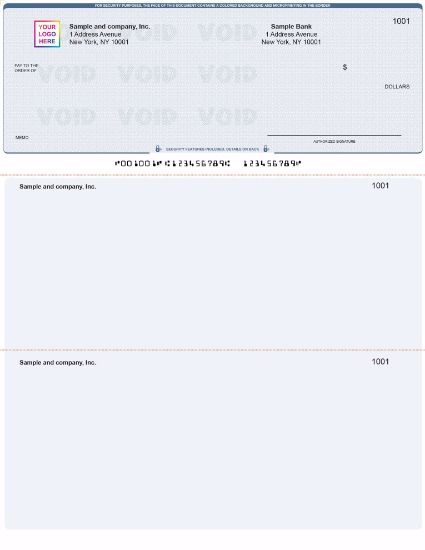
| Voided checks | Explain gaps in the check number sequence. | Taped into the register or scanned with it. |
| Deposit slips | Match deposits to customers and invoices. | Bank copy and your files. |
| Bank reconciliations | Show that your books agree with the bank. | Accounting software or paper worksheets. |
| Stop payment confirmations | Link a stopped check to its replacement. | Email or letter from the bank. |
| Payroll check records | Support wages and employment taxes. | Payroll system and check register. |
Should you keep voided checks?
Yes. A voided check explains why a number is missing from your sequence, so keep it with your register and note the reason. Our guide to the voided check shows how to void one correctly, and how to use a check register covers the entries to make.
Why do deposit slips matter?
They tie each deposit to the customers behind it. Our guide to filling out a business deposit slip explains what to write so the slip is useful years later.
Do you still need canceled checks if your bank only sends statements?
You may not need the physical check, but you do need proof of payment. IRS Publication 583 says that when you do not have a canceled check, you may be able to prove payment with certain financial account statements. For checks, the statement has to show the date the bank posted the amount, and it has to be legible. The same publication warns that proof of payment alone does not establish a deduction, so you still need the invoice or receipt behind it.
| Source | What it shows | Watch out for |
|---|---|---|
| Returned canceled check | The payee, endorsement and amount. | Many banks no longer return paper checks. |
| Check image on your statement or portal | The front and often the back of the paid check. | Download images before online access expires. |
| Bank statement | The date the bank posted the payment. | Must be legible, with the posting date visible. |
| Copy requested from your bank | A reproduction of the paid check. | Banks may charge a fee and take time to respond. |
How long does a bank keep copies of your checks?
The Office of the Comptroller of the Currency says that banks it regulates that do not return canceled checks must keep the checks or a copy for five years, and must provide a copy within a reasonable time after you ask (OCC guidance on canceled checks). Your own retention period may be longer than five years, so do not rely on the bank alone.
Can you keep check records electronically instead of on paper?
Yes, if your storage system meets IRS requirements. Publication 583 says that all requirements that apply to hard copy books and records also apply to electronic storage. The original paper records may be destroyed if the system has been tested and compliance procedures are in place. A computerized system must produce legible records that reconcile with your books and your return.
- Scan clearly. Make sure the check number, amount, date, payee and both sides are readable.
- Name files consistently. Use the date and check number so one search finds the item.
- Store backups. Keep a second copy in a different place from the first.
- Test retrieval. Open a few random files every quarter to confirm they are complete.
- Document the system. Write down how scanning, naming and backup work, and who is responsible.
- Keep paper until the system is proven. Destroy originals only after the checks above are in place.
How should you organize check records so they are easy to find?
A simple structure beats a clever one. Sort by tax year, then by month, then by check number. Keep the bank statement, the register page and the reconciliation for a month together so one folder answers every question about that month.
- Use one numbering sequence. Sequential check numbers make gaps obvious.
- Record at the time of writing. Fill in the stub or register as you sign, not later.
- Reconcile every month. Mark each cleared check and note anything outstanding.
- Label the year. Put the tax year on the folder or file path before you close it.
How does check numbering help with retention?
Every number should be accounted for: paid, voided, stopped or outstanding. That is easier when your checks are printed in order. Our guide to ordering business checks for the first time explains how to set the starting number, and stop payment on a check shows how to document a stopped item. If you write by hand, the manual 3-per-page binder format keeps stubs and checks together.
How long does a check take to clear, and does it affect your records?
A check you wrote is not final in your books until it clears the bank, so keep it marked outstanding. Our guide to how long it takes for a check to clear explains the timeline.
When should you keep records longer than the IRS minimum?
The IRS minimum is a floor, not a ceiling. Before you discard records, the IRS advises checking whether another party requires you to keep them longer, and it names insurers and creditors as examples.
| Situation | What to do |
|---|---|
| You bought equipment or other property | Keep the payment records until the limitations period ends for the year you dispose of it. |
| A lender or insurer requires records | Follow the longer period in your agreement. |
| You are in an audit, dispute or lawsuit | Keep everything related until it is fully resolved. |
| You are unsure which period applies | Ask your accountant before you shred anything. |
| Your state or industry has its own rules | Confirm the requirement with your accountant or the relevant agency. |
How do you dispose of old check records safely?
Old checks and statements still show your business name, address, routing number and account number, so do not toss them in the recycling bin. Shred paper records, and delete electronic copies from every device and backup once the period ends. Keep a short destruction log with the date and the years covered. Our article on check washing explains why account details on a check are worth protecting.
What should you do next?
- Ask your accountant which retention period applies to your business.
- Sort your check records by tax year and check number.
- Decide whether to scan, and write down how the system will work.
- Download bank statements and check images regularly, not only when you need them.
- Mark your calendar with the date each year of records can be reviewed for disposal.
If you need new checks with clear numbering, contact us and we will help you choose the right format.
Why businesses order checks from Checks Next Day
Printed with your bank details. You enter your routing number, account number, starting check number, and business name and address when you order.
Same-day production on weekday orders. Orders placed before 2:00 PM Eastern, Monday through Friday (excluding holidays), are produced and shipped the same business day for next-day arrival, as long as the details are complete and verified.
Formats that match how you work. Choose computer checks, manual business checks or blank check stock to suit your software and workflow.
Faster reorders. Reorders usually move faster because artwork and specifications are already on file.
About the Author
The Checks Next Day team writes about business checks, check printing and check safety for small businesses.