- - -
- hours mins seconds
to get your checks by
Tuesday, Sep. 29th

 0
0 You have no items in your shopping cart.
High-Security Business Checks: Every Feature Explained
High security business checks are checks printed on tamper-resistant stock that layers multiple fraud deterrents, such as microprinting, a void pantograph, chemically reactive paper, and watermarks, into one document. The layers work together: each feature defends against a different attack, from check washing to counterfeiting to forgery.
Standard check stock leaves most of those attacks unanswered. This guide explains what separates secure business checks from basic paper, how the protection changes across manual, computer, and QuickBooks formats, and what to verify before you place an order.
TL;DR: High-Security Business Checks at a Glance
In a hurry? Here is the whole guide in five lines.
- High security means layered features. One feature stops one type of fraud. Quality stock combines microprinting, void pantograph, chemical wash protection, watermarks, and more.
- Every format can be secure. Manual books, computer checks, QuickBooks formats, and blank stock all come on protected paper.
- The MICR line is the anchor. Bank details print in magnetic ink to banking specifications, on pre-printed checks before shipping or via MICR toner on blank stock.
- Paper is half the defense. Pair secure checks with positive pay at your bank to match every check presented against the checks you actually issued.
- Speed does not cost security. Orders placed before 2:00 PM EST Monday through Friday ship the same day on secured stock.
What Makes a Business Check High Security?
The difference is not one magic feature. It is layering.
Check fraud comes in three flavors: washing, where chemicals erase the payee or amount; counterfeiting, where the check is copied or scanned; and forgery or alteration, where printed details are changed. A check protected by a single feature is protected against a single attack.
High security business checks stack defenses so that whichever route a fraudster tries, at least one layer exposes the attempt before your bank pays it.
The Security Features That Matter Most
Here is the working set, and the fraud each one is built to stop.
| Feature | What it does | Stops |
|---|---|---|
| Microprinting | Tiny text that blurs when copied or scanned | Counterfeiting |
| Void pantograph | Hidden pattern that prints VOID on photocopies | Counterfeiting |
| Chemically reactive paper | Stains visibly when washing chemicals touch it | Check washing |
| Security screen | Background wording that vanishes on copies | Counterfeiting |
| Watermark | Visible at an angle, absent on reproductions | Counterfeiting |
| Heat-sensitive ink | Reacts to fingertip warmth as an instant authenticity test | Counterfeiting |
| Toner adhesion coating | Bonds printed details so they cannot be lifted or scraped | Forgery and alteration |
The MICR line anchors all of it. Your ABA routing number and account number print along the bottom edge in magnetic ink to banking industry specifications, which is what lets bank equipment process the check and flag documents that do not read cleanly.
Are High Security Checks Worth It?
The honest math: a single successful check washing incident typically costs more than years of secure check stock. The check that leaves your office carries your account number, your signature, and your business name. Recovering from fraud means bank disputes, stopped payments, new accounts, and reprinted stock, all while vendors wait.
Secure stock is the cheap insurance in that equation. For a business writing checks regularly, the question is less whether the protection is worth it and more why anyone would mail an unprotected document with their account details on it.
High Security Manual Business Checks
Handwritten checks need the protection most, because they travel. A pocket book rides in a vehicle, a deskbook sits in an open office, and every check written by hand is complete and cashable the moment it is signed.
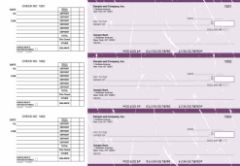
Our manual business checks print on secured stock across all five formats: accounts payable, multi purpose, payroll, pocket, and executive deskbook. Each check includes a stub, so your handwritten record exists from the moment of payment, which is itself a fraud control since altered checks get caught fastest by a bookkeeper comparing stubs to statements.
High Security Computer and Laser Checks
Computer checks arrive with your bank details and MICR line already printed to specification, so the most sensitive part of the document is produced under controlled conditions rather than in your office.
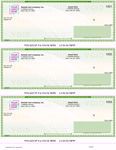
All four layouts of our computer checks, check on top, check in middle, check on bottom, and 3 per page, run through any standard laser or inkjet printer with no MICR toner required. Security features are standard, along with a range of colors, and the toner adhesion layer matters here specifically: the payee and amount your printer adds are exactly what forgers target.
High Security Business Checks for QuickBooks
Running QuickBooks does not change the security question, only the format. QuickBooks-compatible checks come on the same secured stock in three formats: voucher checks with the check on top for payroll and accounts payable, 3 per page for volume, and wallet checks for personal-size printing from QuickBooks Desktop.
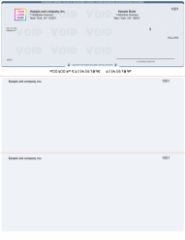
Browse the secured range under QuickBooks checks. Voucher and 3-per-page formats cover both QuickBooks Desktop and QuickBooks Online.
Blank Check Stock: Security When You Print Everything
Blank check stock carries no bank details until your laser printer adds them with MICR toner. That flexibility, one paper for every account, comes with a responsibility: the stock itself must carry the security, because there is nothing else on the page until you print.
Our blank checks use secured stock in the same four layouts as computer checks. Store blank stock locked and count sheets like cash: a stolen blank check is more dangerous than a stolen pre-printed one, since a thief can print any account details onto it.
Pair the Paper With Positive Pay
Secure paper stops fraud on the document. Positive pay stops it at the bank.
Positive pay is a bank service where you send a list of every check you issue, with check number, amount, and payee. When a check is presented for payment, the bank matches it against your list and flags anything that does not line up, including washed amounts and counterfeit check numbers.
Ask your bank about it, especially if you print checks in volume. High security stock plus positive pay covers both ends of the transaction: the paper defends itself in the wild, and the bank verifies it at the finish line.
How to Order High Security Business Checks
Five checks before checkout:
- Match the format to your workflow. Handwritten payments call for manual books. Software printing calls for computer or QuickBooks checks in the layout your print settings expect. Multiple accounts call for blank stock with MICR toner.
- Copy your bank details from an existing check. Routing number, account number, and starting check number, taken from the same account, never from memory.
- Continue your check number sequence. Unbroken numbering keeps reconciliation clean and makes missing checks visible fast, which is a fraud control in itself.
- Keep the logo print-friendly. Logo setup is free with black artwork on a white background in BMP or JPG format. Color logos are available on standard orders but are not eligible for overnight shipping.
- Beat the cutoff. Orders placed before 2:00 PM EST Monday through Friday print and ship the same business day for next business day arrival, with free shipping.
About the Author
This guide was written by the Checks Next Day production team, which has printed and shipped secured business checks across the United States since 1997. The team works daily with security check stock, MICR printing specifications, and every major business check format, and reviews each guide against current industry standards before publishing.