
- - -
- hours mins seconds
to get your checks by
Thursday, Nov. 19th

 0
You have no items in your shopping cart.
Expense Reimbursement Checks: Accountable Plans, Records and the Separate Payment Rule
Last updated: November 17, 2026
Reimbursing somebody for a tank of fuel feels like the simplest payment a business makes. It is also one of the few where the method of payment carries a tax consequence, and almost nobody mentions that part.
Quick Summary
A reimbursement paid under an accountable plan is not income to the employee, is not reported on the wage form and carries no payroll tax. Fall outside the plan rules and the same money becomes wages. If you pay a reimbursement in the same payment as wages, the federal regulation requires it to be separately identified, and making a separate payment is one of the two ways to do that.
- An accountable plan has three conditions, and failing any one turns the money into wages.
- Substantiation has a 60 day safe harbor, with 120 days to return an excess.
- Receipts are required for lodging and for larger single items.
- Four elements must be recorded: amount, time, place and business purpose.
- A separate payment is one of two ways to identify the reimbursement.
- Paying more than the cost pushes the surplus into the overtime rate.
The difference between the two plan types is the whole subject in one table.
| Outcome | Accountable plan | Nonaccountable plan |
|---|---|---|
| Employee's gross income | Excluded | Included |
| Reported on the wage form | No | Yes, as wages or other compensation |
| Employment taxes | Exempt from withholding and payment | Due |
| What it needs | Business connection, substantiation, return of excess | Nothing, which is why it costs more |
What follows is general information about reimbursement practice rather than tax or legal advice. The rules are federal, the reimbursement mandates are state by state, and the figures are revised, so your accountant is the person to confirm anything here before you rely on it.
On the mechanics, the claim reference needs somewhere to live, and the stub on business checks is where it goes. That is what makes a reimbursement traceable a year later.
What this guide covers
- Is a reimbursement taxable to the employee?
- What makes a plan accountable?
- How long does the employee have?
- What must the claim record?
- Separate check or through payroll?
- Are you required to reimburse at all?
- What about mileage?
Is a reimbursement taxable to the employee?
Not if it comes through an accountable plan. The federal regulation states that amounts treated as paid under such a plan are excluded from the employee's gross income, are not reported as wages or other compensation on the employee's wage form, and are exempt from the withholding and payment of employment taxes.
Get it wrong and the treatment reverses entirely. Where an arrangement fails the conditions, the amounts must be reported as wages or other compensation on the employee's wage form, and the whole arrangement is treated as a nonaccountable plan.
Notice that it is all or nothing per arrangement. This is not a per claim test you can fix afterwards, which is why the process matters more than any single receipt.
What makes a plan accountable?
Three things, and the first one is narrower than people expect. The regulation requires reimbursements only for business expenses that are allowable as deductions, which rules out paying a personal cost through the same route.
- Business connection: the expense was incurred doing the job.
- Substantiation: the employee evidences it to you within a reasonable period.
- Return of excess: anything advanced and unspent comes back.
Write the plan down even though no form is prescribed. A one page document naming the three conditions, the claim route and the deadlines is enough, and it is the thing an examiner asks for first.
How long does the employee have?
The regulation offers a fixed date safe harbor with two clocks. An expense substantiated to the payor within 60 days of being paid or incurred is treated as substantiated within a reasonable period. An amount returned to the payor within 120 days is treated as returned within a reasonable period.
Set your internal deadline shorter than both. A 30 day claim window and a 60 day advance settlement rule keep you comfortably inside the safe harbor and stop a year end scramble.
What if the deadline is missed?
The money becomes wages, and the timing is specific. Where expenses are not substantiated within a reasonable period, the amount is treated as paid as wages subject to withholding, no later than the first payroll period following the end of that period.
In practice that means an unsubstantiated advance has to be run through payroll rather than quietly written off. Catching it in the month is far easier than correcting a wage form later.
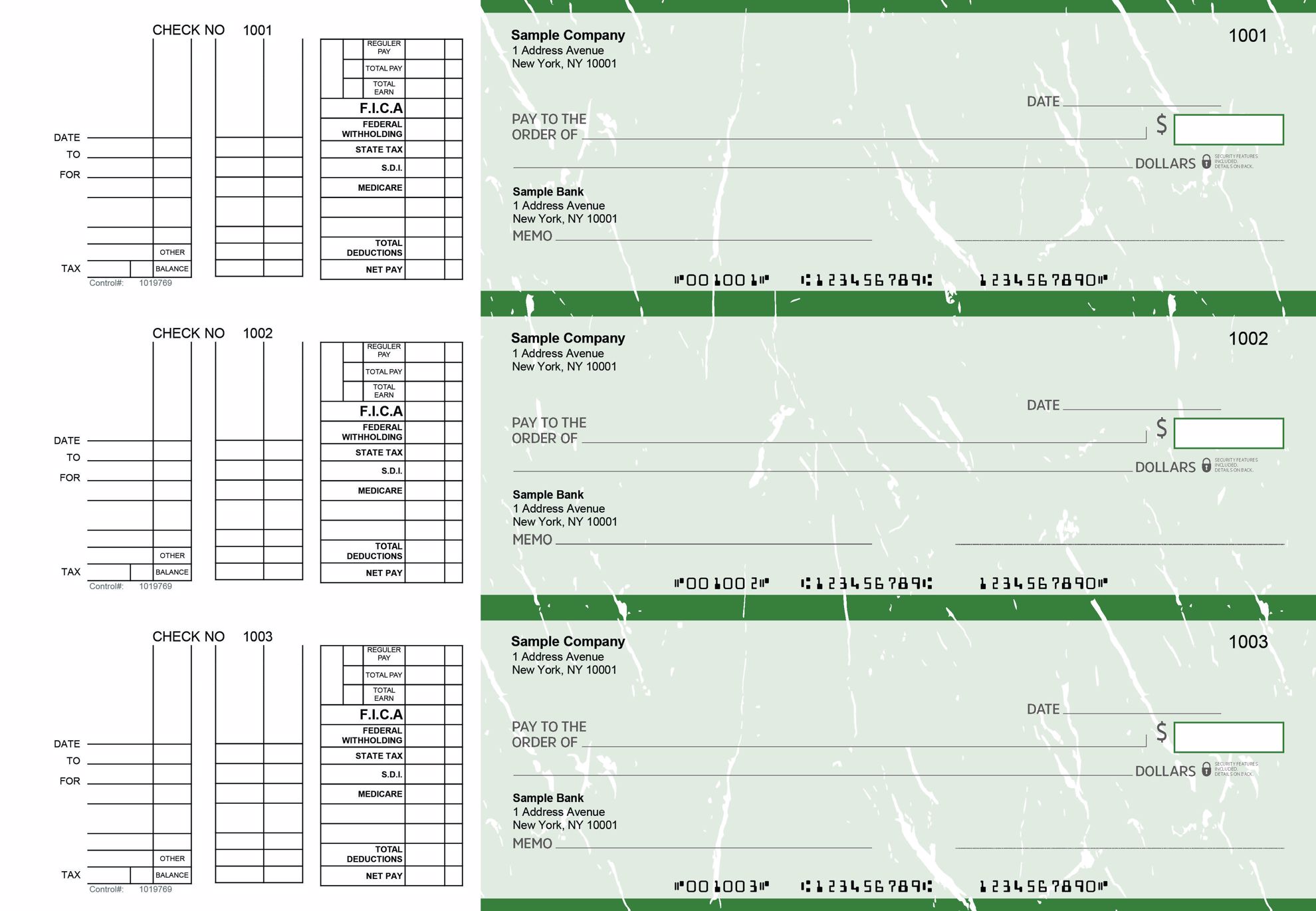
A reimbursement paid on its own needs ordinary operating account stock. See multi purpose business checks for that format.
What must the claim record?
Four elements for travel, and a receipt once the amount passes a threshold. Federal regulation requires the claim to substantiate the amount, time, place and business purpose of the expense, which is a useful shape for any claim form rather than only for travel.
On receipts, the rule is more forgiving than most policies assume. Documentary evidence is required for any lodging cost, and for any other expenditure of 75 dollars or more.
- Keep the form to one page, or people will not complete it.
- Ask for the business purpose in words, not a cost code.
- Require the receipt above your own threshold, which can be lower than the federal one.
- Have someone other than the claimant approve it, always.
- Staple the receipt to the approved claim and file them together.
Pay quickly once it is approved. An employee out of pocket for six weeks stops spending their own money on your behalf, and that costs more than the admin ever saved.
Separate check or through payroll?
This is the question nobody answers, and there is a federal regulation that speaks to it directly. Where a reimbursement is paid in the same payment as wages, the amount must be identified either by making a separate payment or by specifically identifying the amount of the reimbursement.
So a separate payment is not merely tidier. It is one of the two methods the regulation names, and it is the simpler of the two to evidence, because the item itself is the identification.
| Route | How the amount is identified | What you must get right |
|---|---|---|
| A separate item | The payment itself, with the claim reference on the stub | Record it against the claim, not as miscellaneous |
| Inside the payroll payment | A specifically identified line on the statement | The line must be visible and labeled as a reimbursement |
| Bundled with no label | Not identified at all | This is the version that creates the problem |
Whichever route you choose, write it into the plan so it is applied the same way every month. A process that alternates is the one that produces an unlabeled payment at the worst possible moment.
What should the stub say?
Name it as a reimbursement, give the claim reference, and keep it apart from any wage figure. Four short fields do it: the claim number, the period or trip it covers, the amount, and the approver. A stub with those four lines answers every later question without anyone opening a file.

A handful of claims settled in one sitting suits sheet stock printed three to a page. Blank checks three per page is that format.
Can you reimburse yourself as an owner?
Where you are an employee of your own company, the same plan rules apply to you, and the discipline matters more rather than less. Adopt the plan formally, claim on the same form everyone else uses, and have the claim approved by someone other than you where that is possible.
An owner reimbursement with no claim behind it looks like a distribution dressed up as an expense, and that is a conversation worth avoiding entirely.
Are you required to reimburse at all?
Not under federal law. A state labor agency puts it plainly: employers do not have to reimburse an employee's out of pocket business related expenses, as far as federal law goes.
Several states say otherwise. California requires that an employer shall indemnify his or her employee for all necessary expenditures or losses incurred in the discharge of their duties. Illinois requires an employer to reimburse an employee for all necessary expenditures or losses incurred by the employee, with the claim submitted within 30 calendar days.
Can an unreimbursed cost breach minimum wage?
Yes, and this is the federal limit that catches people out. Federal guidance on deductions states that where an employee bears a cost that is primarily for the employer's benefit, it may not reduce the employee's wage below the minimum wage.
What if you reimburse more than the cost?
The surplus becomes pay for overtime purposes. Federal regulation treats genuine expense reimbursements as outside the regular rate, but where the payment exceeds the expense actually incurred, the excess amount will be included in the regular rate.
What about mileage?
Mileage is the most common reimbursement and the easiest one to get wrong, because the rate moves. For 2026 the business standard mileage rate changed part way through the year: 72.5 cents per mile from January 1 to June 30, and 76 cents per mile from July 1 to December 31. The 2025 rate was 70 cents for the whole year.
Check the figure before each policy update, and state the period it applies to on the claim form. A mid year change is exactly the thing a spreadsheet template keeps paying at the old rate for months.
- Record the miles, the date and the journey purpose, not a monthly total.
- Keep the rate used on the claim, so a later review can follow it.
- Pay no more than the rate unless you intend the excess to count as pay.
- Separate commuting from business travel, because they are treated differently.
Can you reimburse a contractor or a volunteer the same way?
Not through the same plan. An accountable plan is built around the employment relationship. A contractor bills you, and the expense usually belongs in the invoice rather than in a claim form.
Volunteers and board members sit somewhere in between. Reimburse the actual cost, ask for the receipt, and keep the approval. Paying a flat allowance with no receipts behind it starts to look like compensation, and that changes how the payment is reported.
- Contractors invoice the cost, with the expense shown as a line.
- Volunteers claim the actual amount, never a round figure.
- Board members use the same form as everyone else.
- Keep every approval, because these are the payments most often queried.
How long should you keep the paperwork?
Keep the claim, the receipt and the approval together, filed by the period they were paid in. Then set the retention period with your accountant and apply it by year.
The claim is the part people throw away. It is also the only document that shows who approved the payment and why, so it is the one worth keeping longest.
Related reading
- Check register covers recording a reimbursement against its claim.
- Check signing policy covers who may approve a claim and who may sign.
- How to write a business check by hand covers a payment written on the spot.
- Types of business checks covers which format suits which payment.
What to do next
Write your accountable plan on one page this week, naming the three conditions, the claim deadline and the advance settlement deadline. That page is the difference between a reimbursement and a wage, and most businesses have never produced it.
Then decide which route the payment takes and order to suit it. Business checks leave room on the stub for a claim number and an approver, while blank check stock fits a business that prints straight from its accounting software.
About the Author
The reimbursement question reaches us through bookkeepers rather than owners, and always in the same shape. They have been told to stop putting expenses through payroll and want a stub with somewhere to write the claim number. That request is a sign of a process working properly.
Plan conditions, substantiation windows, the receipt threshold and the identification rule above come from federal tax regulations, and the reimbursement mandates from California and Illinois law. The mileage figures were taken from current federal guidance and are revised regularly, so confirm them before you publish a policy.