
- - -
- hours mins seconds
to get your checks by
Tomorrow, Nov. 13th

 0
You have no items in your shopping cart.
Earnest Money Check: Who Holds It and What Happens Next
Last updated: November 12, 2026
The earnest money check is often the largest payment a person has written in their life, handed over in a hurry, to someone they met a fortnight ago. It usually goes perfectly. The times it does not nearly always trace back to one line on the document.
Quick Summary
An earnest money check is a good faith deposit held by a neutral third party while a contract runs. It should be payable to the escrow holder named in the agreement, it has to be banked into a qualifying account quickly, and the contract rather than goodwill decides where it ends up.
- Never payable to the seller, and never to an individual agent.
- Banked immediately in some states, within a set number of days in others.
- It goes into an insured escrow or trust account, not an operating account.
- The broker is a signatory on escrow accounts under the rule used here.
- At closing it is credited, reducing what you owe on the day.
- Keep three documents as proof, and keep them together.
Here is where the deposit can legitimately sit, and where it must not.
| Payable to | Is that right? | Why |
|---|---|---|
| The brokerage escrow account | Yes, where the contract says so | Held in trust under rules the broker must follow |
| A title company or attorney | Yes, where named as holder | Same neutral holder principle |
| The seller personally | No | It stops being escrow and becomes an unsecured payment |
| An individual agent | No | Funds belong in the brokerage account, not a person's |
Background rather than advice, and not real estate guidance. Escrow handling is regulated state by state, so your state's regulator, the closing agent on your transaction and your attorney are the people to confirm anything here.
A deposit needs to be traceable to a property and a contract, which is what the stub on business checks is there to record.
What this guide covers
- What is earnest money?
- Who should the check be payable to?
- How quickly must it be banked?
- What kind of account must hold it?
- What happens at closing or on termination?
- What should you keep as proof?
- What should a small brokerage get right?
What is earnest money?
It is a deposit a buyer puts up to show the offer is serious, held by a neutral party while the contract runs. The money is not a fee and it is not the seller's yet. It sits with a holder until the contract tells everyone where it goes.
People often confuse it with the down payment, which is understandable because the deposit is usually credited toward what the buyer owes. The difference is who holds it and when. Earnest money is held by a third party during the contract, and a down payment is paid at closing.
Who should the check be payable to?
The escrow holder named in the contract, written exactly as the contract names them. That is usually a brokerage, a title company or an attorney, and the payee line is the single detail worth slowing down for.
- Copy the name from the contract, not from an email signature.
- Include the words escrow or trust where the contract uses them.
- Write the property address on the memo line so the holder can apply it.
- Never leave the payee line blank for someone else to complete.
- Verify any change of instruction by phone, using a number you already had.
That last point is not theoretical. Payment instructions sent by email are a well worn fraud route in property transactions, and a two minute call to a number you looked up yourself is the entire defense.
Record the contract reference where you will find it again. See blank checks on the bottom for stock with room above.
How quickly must it be banked?
Sooner than buyers expect, and the holder has no discretion about it. Florida, used here as a worked example, requires a broker who receives funds to immediately place them in a qualifying account, and the rule covers money the broker receives from sales associates as well.
Other states count days instead. Several give a fixed number of business days from receipt or from contract acceptance, so the deadline that applies to your transaction comes from your own state's rule and the contract.
What if the check is held uncashed?
Ask why, in writing, and keep the answer. There are legitimate reasons a deposit has not been presented yet, such as a contract that is not fully executed, and there are reasons that should concern you. Either way the question is reasonable and a professional holder will expect it.
What kind of account must hold it?
An insured escrow or trust account, kept apart from the holder's own money. The Florida rule names the permitted institutions: a bank, savings and loan association, trust company, credit union or title company having trust powers.
The same rule addresses who can move the money. The broker must be a signatory on all escrow accounts, and where a brokerage has more than one broker licensee, one of them may serve as the signatory.
Our guide to check signing policy covers the same principle inside a business, which is that the person who moves money is named in advance rather than chosen on the day.
What happens at closing or on termination?
At closing the deposit is applied to what the buyer owes, so it reduces the money needed on the day. It should appear as a credit on the closing statement, and it is worth checking that line rather than assuming it.
When a deal ends early, the contract decides. A contingency exercised within its deadline usually returns the deposit to the buyer, and a buyer who walks away outside the agreed terms usually does not get it back.
- Read the contingency deadlines before you need them, not after.
- Give notice in the form the contract requires, and keep proof of it.
- Expect written release instructions signed by both sides before funds move.
- Understand that a disputed deposit sits still, because the holder is neutral.
- Take advice early in a dispute, since these follow a set procedure.
The holder is not being obstructive. An escrow holder who releases money to one side without authority is the one who ends up in trouble, which is exactly the protection the arrangement exists to give you.
What should you keep as proof?
Three documents, kept together from the day you hand the deposit over. Most disputes about whether a deposit was paid are really disputes about missing paperwork.
- A copy of the front of the check, showing the payee and the memo line.
- The written receipt from the escrow holder, dated.
- The contract clause naming the holder and the amount.
- The bank record showing when the item was presented.
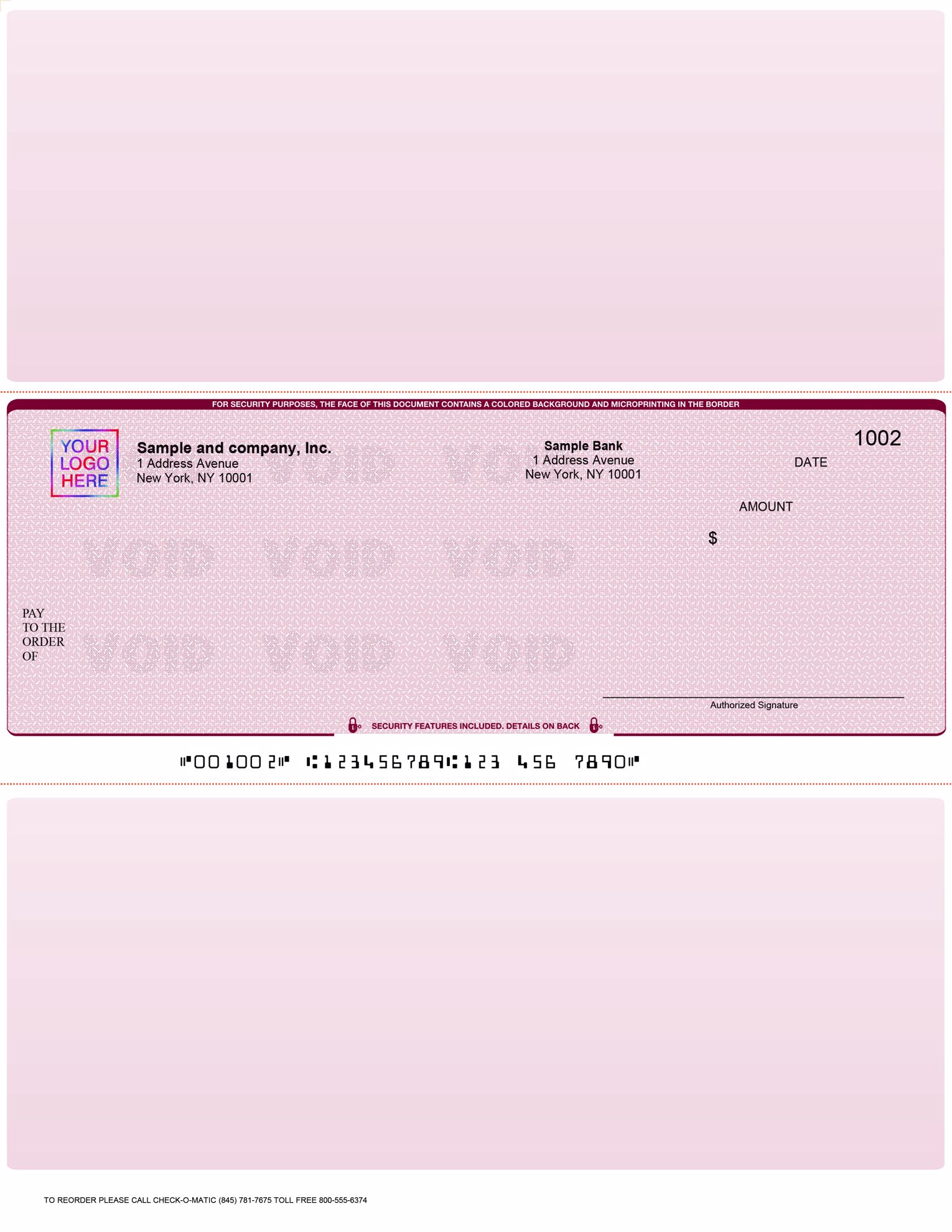
Two stubs give you a copy for the file and one for the transaction. See business checks in the middle for that layout.
What should a small brokerage get right?
The handling, not the paperwork around it. A small office holding other people's deposits is running a trust operation, and the expectations are the same as for a much larger firm.
| Control | What good looks like |
|---|---|
| Separate account | Escrow funds never touch the operating account |
| Named signatory | The broker, with cover arranged in advance |
| Same day banking | Deposits leave the office the day they arrive |
| Receipt issued | Written, dated, and sent without being asked |
| Monthly reconciliation | Account balance ties to the open file list |
Why does reconciliation matter so much here?
Because the account holds money belonging to several unrelated people at once. A shortfall is not a bookkeeping error in that situation, it is one client's deposit funding another client's disbursement, and that is how an otherwise honest office ends up in front of a regulator.
Tie the balance to a list of open files every month, and keep the working. It takes an hour and it is the document that answers every question an examiner will ask.
What about interest on the account?
That is set by your state and sometimes by the contract. Some states direct interest on escrow deposits to a public program, some allow the parties to agree who receives it, and some require a separate interest bearing account where the sum is large or the holding period is long.
Whichever applies, decide it before you take the deposit rather than afterwards. A holder who has to work out where interest belongs while a deal is collapsing is making that decision under exactly the wrong conditions.
Related reading
- Check signing policy covers naming who may move money in advance.
- Check register covers the record of a large one off payment.
- How to write a business check by hand covers the payee line.
- Check washing covers protecting a large payment in transit.
What to do next
Before you write the deposit, read the escrow clause in the contract and copy the holder's name from it onto the payee line. If anyone asks you to make it out differently, ring them on a number you found yourself and ask why.
If you are the business holding deposits, set the stock up for it. Business checks are printed with the stub space a transaction reference needs, and high security business checks suit payments of this size.
About the Author
Title companies and small brokerages come to us for one thing above all, which is a wider stub. A disbursement with the property address printed beside it saves a phone call, and in this business the calls rarely come from people in a calm mood.
Timing, account type and the signatory requirement above come from a Florida escrow rule. It is used here only to show what a typical rule looks like, because every state writes its own. Your regulator and your contract set the actual requirements.