- - -
- hours mins seconds
to get your checks by
Tomorrow, Oct. 30th

 0
You have no items in your shopping cart.
Counter Checks and Starter Checks
Last updated: October 29, 2026
Most pages on this subject list what each bank charges. The more useful questions are whether these items are valid at all, why payees turn them down, and what a brand new business account should do instead.
Quick Summary
A counter check is a blank check issued at a branch against an existing account, and a starter check is the handful given out when an account is opened. Both carry the routing and account numbers but not the printed name, which is exactly why they clear at the bank and get refused at the counter.
- They are real checks. The code requires an order to pay a fixed sum on demand drawn on a bank, not a printed name.
- Refusal is policy, not law. No federal rule obliges anyone to take one, so acceptance varies payee by payee.
- The missing name is the problem. There is nothing printed to match the signature or the business against.
- Direct deposit forms usually reject them. The form wants a voided check showing the printed account holder name.
- Some accounts cannot use them at all. A state rule on lawyer trust accounts rules starter checks out in one line.
- New accounts are slow by rule. An account counts as new for its first 30 calendar days under the availability rules.
Here is how the three options compare on the things that decide whether a payment goes through.
| Item | What is printed on it | Where it tends to fail |
|---|---|---|
| Counter check | Routing and account numbers, usually no name or address | Payee refusal, no record of what it paid |
| Starter check | Account details, low or absent check numbers | Refusal, plus rules that bar them for some accounts |
| Printed business check | Business name and address, sequential numbers, security features | Needs ordering, which takes a day rather than a week |
What follows is background on how these items are issued and who accepts them. It is not legal or banking advice. Every bank writes its own rules here, so ask yours directly what it will hand out and what it will take in.
If the gap you are filling is a new account waiting on stock, business checks are produced the same day an order is approved.
What this guide covers
- What is a counter check?
- What is a starter check?
- Is a counter check a valid check?
- Why do people refuse them?
- Can you use one to set up direct deposit?
- Can a business pay vendors with them?
- Why is a new account slow with deposits?
- How fast can you get printed checks instead?
What is a counter check?
A counter check is a blank check a bank prints or hands over at the branch, on request, drawn on an account you already hold. It carries the routing and account numbers needed for clearing, while the lines where a name and address usually sit are blank or completed by hand.
The usual reason for asking is running out. Someone needs to pay a bill today, the printed book is empty, and the branch can produce something that will clear.
What is a starter check?
A starter check is one of the small batch of blank checks a bank provides when an account is opened, to cover the days before printed stock arrives. It has the account details but not the printed name, and the numbering normally starts very low or is left off entirely.
That low number does more damage than the missing name. A check numbered in single digits announces a new account to anyone looking, which is precisely the signal fraud screening is built to catch.
Are counter checks and starter checks the same thing?
They are close cousins. A starter check arrives with a new account, while a counter check is issued later against an account that already exists. The practical difference is the story each one tells a payee: one says new customer, the other says ran out of checks.
Is a counter check a valid check?
Yes. The commercial code sets out what makes an instrument a check: an unconditional order to pay a fixed amount of money, payable to bearer or to order, payable on demand, drawn on a bank, with no other undertaking added by the drawer.
Nowhere in that definition is a preprinted name or address required. So the blank identification lines do not affect validity at all. What they affect is whether anybody will take it.
That gap between valid and accepted is the whole story here. The bank can pay it and the payee can still refuse it, and both are behaving correctly.
Why do people refuse them?
Because acceptance is a decision rather than a duty, and nothing on the item helps the person making it. Banking guidance makes the underlying position plain. Cashing an item for someone who banks elsewhere is not something federal rules compel, and each bank decides for itself what it will do with a check that has been signed over.
Payees apply the same logic in their own way. These are the specific objections that come up.
- No printed name to match. The signature cannot be compared against anything on the document.
- No address. A returned item leaves nobody obvious to chase.
- A very low or missing number. Screening treats that as a new account with no history.
- Handwritten identification. Anything added by pen can be added by anyone.
- No security printing. There is little to examine if the item is later disputed.
Printed stock answers all five at once, which is why the fix is usually to get real checks rather than to argue. What an examiner actually looks at on a printed item is covered in blank check security features.
Can you use one to set up direct deposit?
Often not. A direct deposit or automatic payment form normally asks for a voided check so the payer can read the account holder's printed name next to the routing and account numbers. An item with no printed name does not satisfy that, and most payroll systems reject it rather than come back with a question.
Where a bank letter or a signed account verification is accepted instead, that is usually the faster route. What the form is really asking for, and how to supply it properly, is covered in what is a voided check.
Can a business pay vendors with them?
Treat it as a last resort, even where the bank will issue them. Three problems stack up for a company that tries, and only the first is obvious.
- Your vendor cannot verify you. There is no printed business name, so the item looks like a personal check written by a stranger.
- You have no record. No stub and no duplicate means the only trace is whatever someone remembered to write down.
- Some accounts are barred from them. A state rule governing lawyer trust accounts rules them out in one line, and insists the checks be pre-printed and pre-numbered instead.
That third point is worth noticing even outside the professions. Where a regulator has thought about check stock at all, the conclusion has been the same: a payment that cannot be traced to a printed, numbered document is a record keeping problem waiting to happen.
A bound book with a stub solves the record problem on its own. Those formats are listed under manual business checks, and a check register does the same job alongside printed stock.
Why is a new account slow with deposits?
Because federal availability rules treat it differently for the first month. An account counts as new during the first 30 calendar days after it is established, unless each customer already held another account at that bank for at least 30 calendar days beforehand.
During that window the rules split by payment type rather than by amount alone.
| What you deposit | Availability in a new account |
|---|---|
| Cash | The business day after the banking day of deposit |
| Electronic payments | The business day after the banking day they are received |
| Checks, up to the rule's threshold | The standard availability schedule applies |
| Checks, the remainder | Not later than the ninth business day after deposit |
Plan the first month around that. A new company that intends to pay suppliers out of deposited checks in week one is planning around availability it does not have yet.
Once the account settles down, the timings in how long it takes for a check to clear take over.
How fast can you get printed checks instead?
Faster than most people assume, which is what makes the counter check question largely avoidable. An order approved before the daily cutoff is produced that day and shipped for next day delivery, so the gap a starter check is meant to fill is usually one working day wide.
What the printer needs is straightforward, and all of it is on your account paperwork.
- The business name and address exactly as the bank holds them.
- The routing and account numbers, which is why a starter check is useful as a reference document.
- A starting check number that does not overlap anything already issued.
- The format, meaning printed voucher stock or a hand written book.
- How many signature lines your own policy calls for.
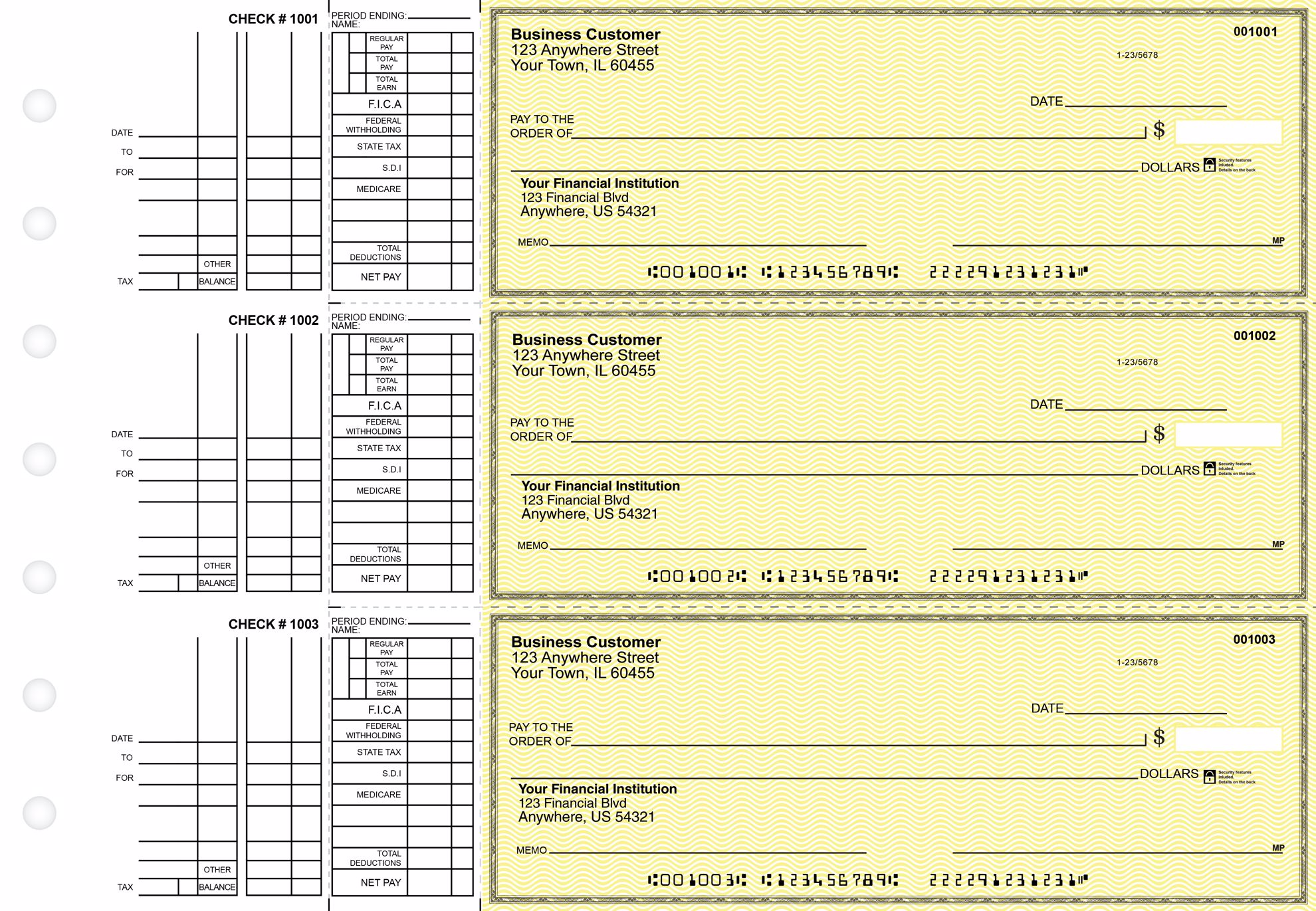
A first order start to finish is set out in ordering business checks for the first time, and needing checks tomorrow covers the cutoff when you have run dry.
Related reading
- What is a blank check explains the term that gets confused with these two.
- Business checks vs personal checks sets out what changes once an account is in a company name.
- Out of checks today covers what to do in the gap.
- Rush checks covers the quickest production route.
What to do next
If you are holding starter checks right now, use one as a reference document rather than a payment: it carries the routing and account numbers an order needs. Then place the order the same day, because the delay people complain about is almost always the ordering rather than the printing.
Business checks are printed with your registered name, your chosen number range and the signature lines you specify, and overnight checks covers the fastest shipping option when the gap is tight.
About the Author
A steady share of the orders Checks Next Day prints come from people reading the numbers off a starter check, often on the day a new account opens. The three details that hold those orders up are always the same: the exact registered name, the starting number, and which format the software expects.
The legal and availability points on this page were taken from the commercial code definition of a check, published federal banking guidance on cashing items, and the federal funds availability rules for new accounts. Each bank applies its own policies on top, so confirm the specifics with yours.