- - -
- hours mins seconds
to get your checks by
Friday, Oct. 30th
Get it tomorrow
AFTER HOUR ALERT
Ooops! You missed todays deadline.
Your order will ship the next business day.
Need checks sooner?
Select the Rush +$25.00 at checkout to receive them tomorrow.
* Submit your order before 5pm EST to enjoy this offer.

 0
You have no items in your shopping cart.
Check 21 and Substitute Checks
Last updated: October 28, 2026
Check 21 is usually explained from the account holder's side: why the paper stopped coming back. The part nobody writes about is what the law expects from the check you print and issue in the first place.
Quick Summary
Check 21 is the Check Clearing for the 21st Century Act, approved on 28 October 2003 and effective twelve months afterwards. It authorized the substitute check, a paper reproduction that can stand in for the original, which is why banks clear images instead of shipping paper to each other.
- It authorized truncation. The original paper can stop early, with an image carrying the payment onward.
- A substitute check is paper, not a screen image. It reproduces both faces of the item and has passed through a bank.
- One printed sentence creates the equivalence. Without the legend the Act prescribes, the reproduction is just a copy.
- Nobody has to keep your original. There is no federal requirement to retain original checks for a set period.
- Consumers get a claim route. Expedited recredit must be raised within 40 days of the statement being sent.
- Print quality became a payments issue. The definition itself is built around a readable MICR line and conforming stock.
Three documents get confused in this area. Here is what separates them.
| Document | What it is | Standing |
|---|---|---|
| Original check | The paper item you wrote and signed | The instrument itself, often truncated early in clearing |
| Substitute check | Bank produced paper, both faces reproduced, MICR line included | Legal equivalent of the original where the conditions are met |
| Image copy | The picture in online banking or on a statement | A record, not the instrument, unless it meets the substitute check conditions |
This page is general information about how checks clear. It is not legal or banking advice, and the disclosures your bank gives you and the agreement on your account are what govern, so raise anything about a particular item there.
On the practical side, business checks are printed with a MICR line and on stock that images cleanly, which is what the clearing process now depends on.
What this guide covers
- What is Check 21 and what did it change?
- What is a substitute check?
- Why do banks no longer return canceled checks?
- What disclosure does a bank have to give you?
- What if a substitute check is charged wrongly?
- What does Check 21 mean for a business that writes checks?
- What records should you keep now?
What is Check 21 and what did it change?
Check 21 is the short title of the Check Clearing for the 21st Century Act, approved on 28 October 2003, with the Act taking effect twelve months after enactment. Before it, a check generally had to travel as paper from the bank of deposit to the bank that would pay it.
The Act set out three aims: to make truncation possible by authorizing substitute checks, to encourage innovation in check collection without forcing any bank to accept items in electronic form, and to improve the efficiency of the national payments system.
That middle aim explains the shape of the law. Rather than compelling electronic exchange, it created a paper document that any bank could accept, which let image exchange spread by agreement instead of by mandate.
What is a substitute check?
It is paper, printed by a bank, standing in for the item you wrote. The statutory definition asks for four things: pictures of both faces of the item it replaces, a MICR line carrying the original's data, paper and dimensions that meet industry standards, and the ability to run through automated processing as the original would have.
Federal Reserve guidance adds two practical details. The sheet runs a little larger than an ordinary personal check so the picture fits, and the document has to have passed through a bank to count as one.
Is a substitute check legally equal to the original?
Yes, where two conditions are satisfied. The reproduction has to carry everything shown on both faces of the original as it stood when that item was truncated, and it has to display the legend the Act sets out word for word: This is a legal copy of your check. You can use it the same way you would use the original check.
Meet both and the Act makes the reproduction the legal equivalent of the original for all purposes. Miss either and you are holding a copy with no special standing.
Is the image in online banking a substitute check?
Usually not. The screen image is a record of the item, which is perfectly useful for reconciling, but a substitute check is a physical paper document produced through the banking system and bearing the legend. If you need the standing rather than the picture, ask the bank for the original or a sufficient copy and say why.
Why do banks no longer return canceled checks?
Because the paper no longer needs to make the journey. Once truncation was permitted, most items began clearing as images and the original stopped at or near the bank of deposit. Federal Reserve guidance states plainly that banks are not required to keep original checks for any specific length of time, and that Check 21 added no new retention requirement.
What you can ask for has changed shape rather than disappeared. On request a bank may provide the original item, a substitute check, or a copy, and which of those you receive depends on the bank and on how long ago the item cleared.
- Ask early. The further back the item, the more likely only an image survives.
- Say what you need it for. A dispute calls for the original or a sufficient copy, not a screenshot.
- Keep your own record at issue time. This is the only copy whose existence you control.
What disclosure does a bank have to give you?
Consumers who get canceled checks from their bank are entitled to a consumer awareness disclosure describing substitute checks and the rights that come with them. Federal Reserve guidance sets out when it has to arrive.
- Existing customers: no later than the first statement mailing.
- New customers: when the relationship is established.
- On request: when a consumer asks for an original or a copy and receives a substitute check instead.
- On a return: when a check the consumer deposited comes back unpaid as a substitute check.
Business accounts sit outside the consumer protections, which is worth knowing before you assume the same route is open. That asymmetry is the main reason a company's own records carry more weight than an account holder's do.
What if a substitute check is charged wrongly?
Consumers have an expedited recredit claim. It applies where the account holder believes a substitute check was charged incorrectly, believes they lost money as a result, and needs the original check or a sufficient copy to work out what happened.
The clock is short at the front end. The claim has to reach the bank no later than 40 days from when the bank mailed or delivered the account statement.
| Stage | Timing |
|---|---|
| Raise the claim | No later than 40 days after the statement was sent |
| Bank agrees the charge was wrong | Refund within one business day of that decision |
| Bank cannot decide yet | A capped portion refunded with interest after 10 business days |
| Remaining loss | By the 45th calendar day counted from the claim |
| Bank finds the charge correct | Notice by the next business day, with the original or a sufficient copy |
Two caveats sit alongside that timetable. A refund can be reversed if the claim is later found invalid, and a bank may delay withdrawal of the capped portion where the account is new, repeatedly overdrawn, or the claim is suspected of being fraudulent, releasing it once the claim is validated, or by the 45th calendar day at the latest.
What does Check 21 mean for a business that writes checks?
It turned print quality into a payments issue. Read the statutory definition again and three of its four elements are about the physical document: a MICR line carrying the original information, paper stock and dimensions conforming to industry standards, and suitability for automated processing.
That means the item you issue has to survive being imaged, reproduced and read by machines you will never see. A check that images poorly is the one that gets rejected, re-keyed or questioned, and none of those happen quietly.
- The MICR line has to read first time. Light toner, the wrong font or a smudged band causes rejects downstream.
- Stock and dimensions matter. Conforming paper is part of the definition, not a preference.
- Security features should survive imaging. A feature that only works in your hand does nothing once the item is a picture.
- Contrast beats decoration. Heavy backgrounds can fight the scan rather than help it.
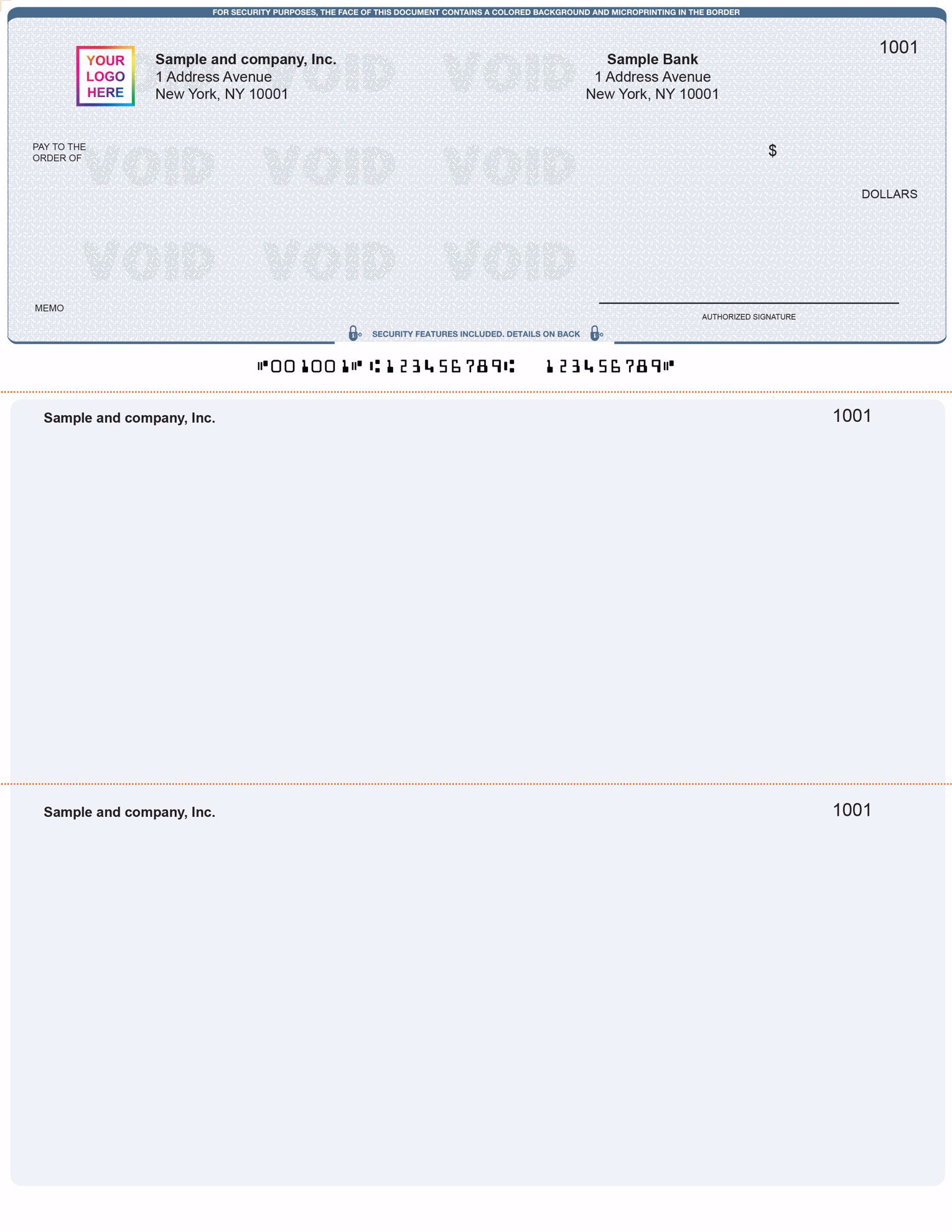
Our guide to the MICR line on a check explains what each field in that band carries, and computer checks covers the printed formats that carry it.
Does the paper you order still matter?
More than it did when paper traveled. Weight and finish affect how cleanly an item scans and how well it survives handling before it gets there, and the security printing you choose decides whether tampering is still visible in an image rather than only under a lamp.
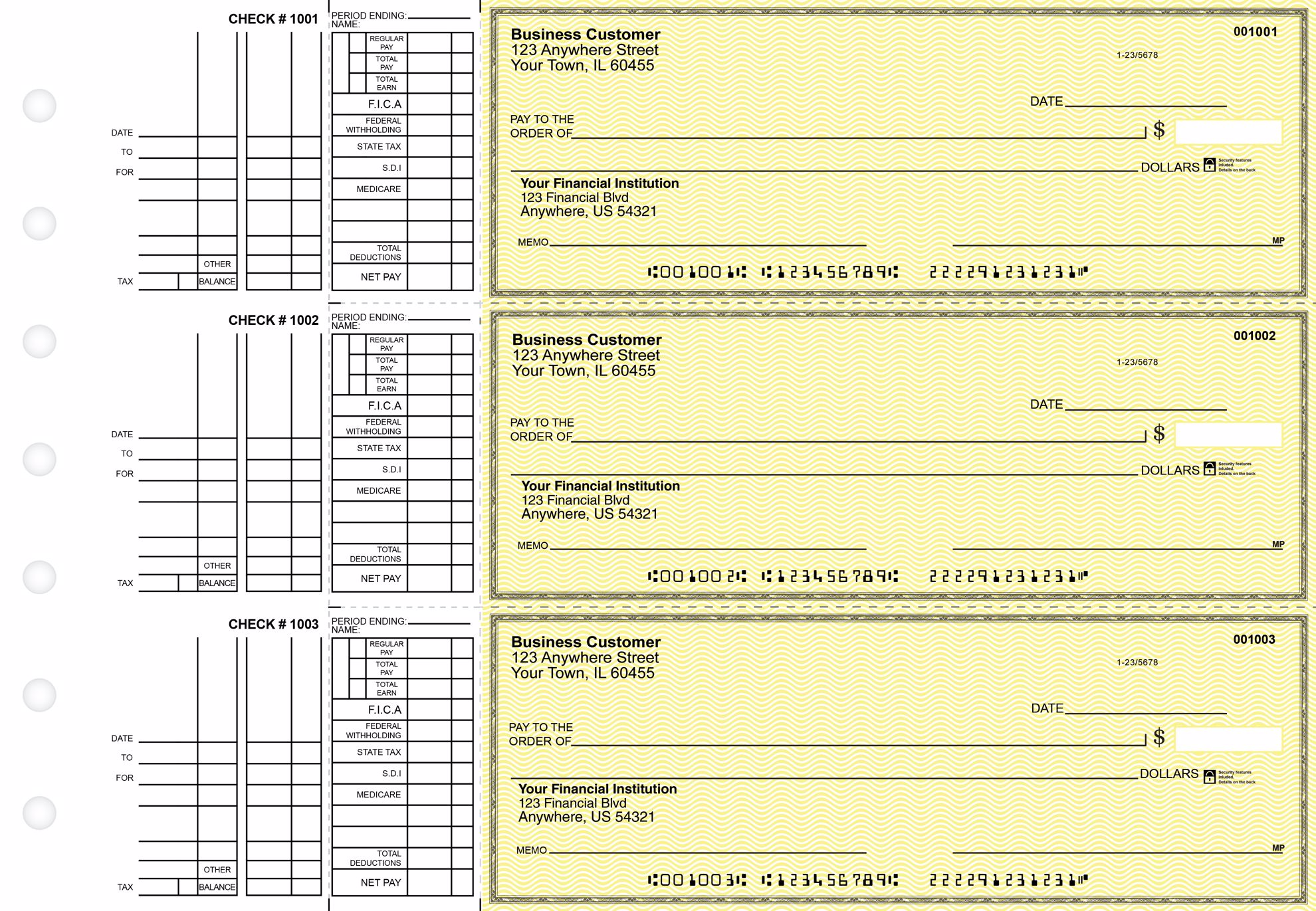
Weight and finish are covered in check paper weight. The feature by feature breakdown sits in blank check security features, and the stock carrying the full set is high security business checks.
What records should you keep now?
Keep the record you create at the moment of issue, because that is the only one whose survival you control. Nobody is obliged to hold your original, and the image a bank holds is retained on the bank's schedule rather than yours.
- The stub or duplicate showing payee, amount, date and purpose.
- The register entry, so the number sequence is complete and searchable.
- Voided items, marked and filed in number order rather than discarded.
- Statements and item images, downloaded on your own schedule rather than left on a portal.
- The supporting document, filed against the check number it paid.
A check register covers the second item, and what is a voided check covers handling the third one properly.
Related reading
- How long it takes for a check to clear covers what image exchange did to timings.
- What is a laser check covers printing onto blank stock and the MICR step.
- Blank check stock covers the unprinted paper side of the same question.
- Types of business checks runs through the formats available.
What to do next
Pull a check you issued in the last month and look at it as a scanner would. Is the MICR band crisp and unobstructed, is the payee line legible at a glance, and would a tamper show up in a grey image? Those three answers tell you whether your stock is fit for an image based system.
If anything there gives you pause, business checks are printed with a machine readable MICR line as standard, and high security business checks add features chosen to stay visible after imaging. Approved orders go into production the same day.
About the Author
At Checks Next Day the MICR band, the paper and the contrast of the printing are daily production decisions rather than theory, because business check stock leaves here for customers across the United States every working day.
The legal detail on this page came from the text of the Act itself and from published Federal Reserve guidance on substitute checks. Disclosures and account agreements are not identical from one bank to the next, so put any question about a particular item to the bank holding the account.