
- - -
- hours mins seconds
to get your checks by
Monday, Nov. 2nd

 0
You have no items in your shopping cart.
Can an Employer Require Direct Deposit?
Last updated: October 30, 2026
The usual answer to this is a table of state rules. The federal provision underneath those rules is simpler, more important, and almost never explained properly.
Quick Summary
An employer can generally require electronic payment of wages, but cannot require that the money land at a bank of the employer's choosing. Federal law protects the employee's choice of institution, and state payday laws add notice and consent requirements on top of that.
- The choice of bank belongs to the employee. Federal law bars conditioning employment on opening an account at a particular institution.
- Two compliant models exist. Require electronic payment while the employee picks the bank, or name a bank while leaving another payment route open.
- Payroll cards sit under the same rule. A card at a named provider cannot be the only way to be paid.
- States add notice. One payday law requires at least 60 days of advance written notice before moving to direct deposit.
- Unbanked staff are the gap. State guidance has called the power to force an account opening an ambiguity in its own statute.
- Keep a paper route. Final checks, failed transfers and non consenting staff all need one.
Here is what an employer can and cannot insist on, before state law is layered over it.
| The employer wants to | Federal position |
|---|---|
| Pay everyone electronically | Not prohibited by the compulsory use provision, where the employee chooses the institution |
| Name the bank everyone must use | Not permitted as a condition of employment |
| Name a bank but offer another route | Treated as compliant in the regulator's own examples |
| Put everyone on one payroll card | Mandating a card at a particular institution is prohibited |
| Make an unbanked employee open an account | Unsettled, and described as an ambiguity in state guidance |
This page is general information about wage payment methods. It is not legal advice, employment and payday laws differ by state and change, and your own obligations depend on where your employees work, so take the detail to employment counsel before you set a policy.
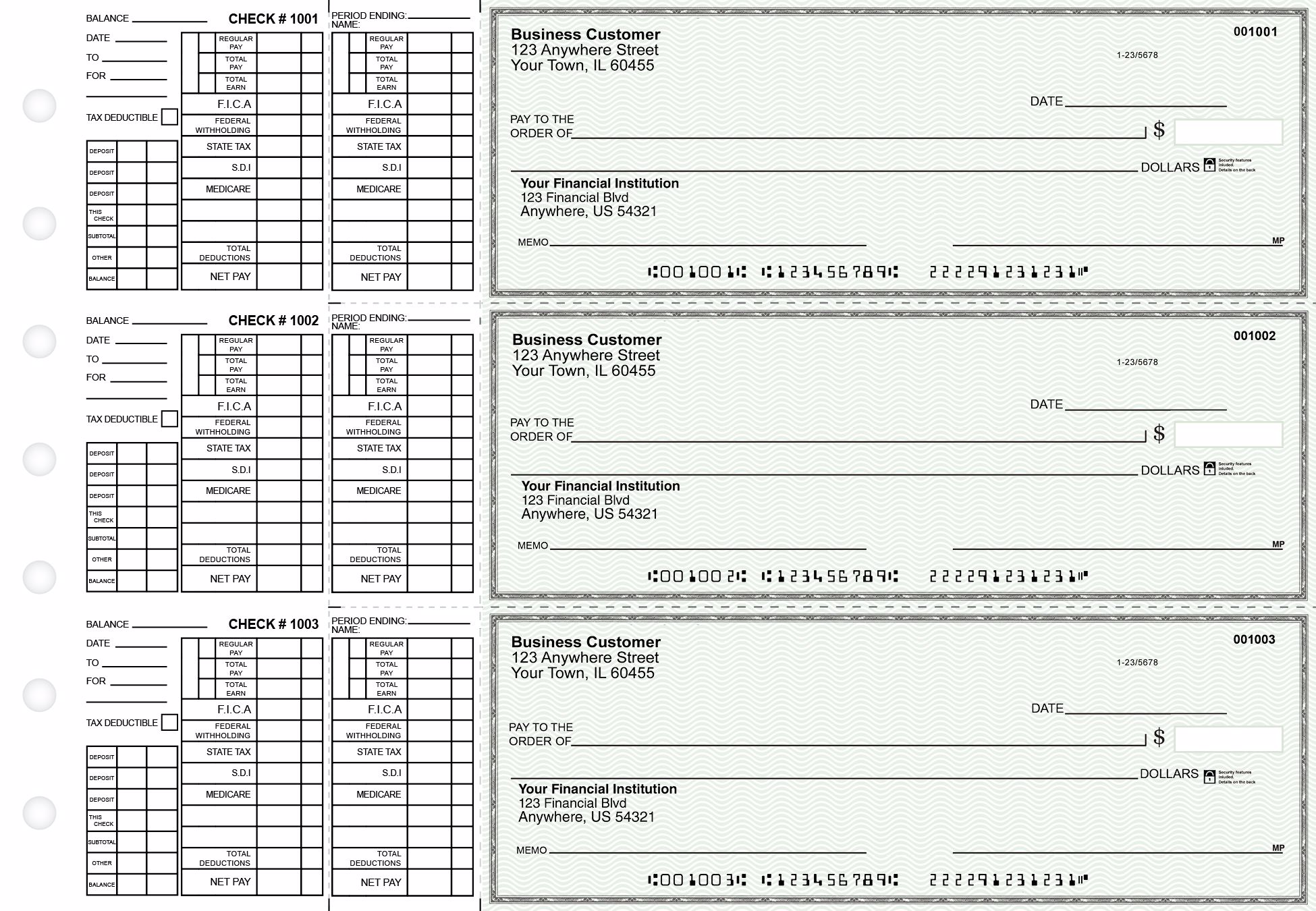
Whatever you settle on, the exceptions need paper. Payroll business checks are printed on their own sequence so a check run stays available without touching accounts payable.
What this guide covers
- Can an employer require direct deposit under federal law?
- Can wages be forced onto a payroll card?
- What do state payday laws add?
- What if an employee has no bank account?
- Why keep paper payroll checks at all?
- What should a paper payroll check carry?
- How do you make the switch cleanly?
Can an employer require direct deposit under federal law?
Federal law does not prohibit requiring electronic payment, but it does prohibit dictating where the money lands. The compulsory use provision of the Electronic Fund Transfer Act, at section 913 of the Act and 15 U.S.C. 1693k, bars requiring a person to establish an account at a particular institution as a condition of employment.
Regulation E implements that at 12 CFR 1005.10(e) and (e)(2). The practical effect is that the question is not really whether direct deposit can be mandatory, but who gets to choose the receiving account.
What does a compliant policy look like?
The regulator's own examples leave two routes open, and they are mirror images of each other.
- Require electronic payment, free choice of bank. Everyone is paid electronically, and each person names the institution that receives it.
- Name an institution, keep an alternative. The employer can designate one, provided the employee can be paid by another method instead.
What fails is the combination of both constraints. One institution, no alternative, and employment conditioned on it is the arrangement the provision was written to stop.
Can wages be forced onto a payroll card?
Not as the only option. Regulator guidance restates that the compulsory use provision prohibits employers, financial institutions and other persons from mandating that wages be deposited to a payroll card at a particular institution.
A card program is therefore an offer rather than a default. One state's payday law shows what that looks like in practice, requiring advance written notice, a complete list of the card's fees, and a form the employee can use to ask for a different payment method.
That same state guidance suggests a card program should allow at least one free cash withdrawal per pay period, which is a useful test of whether a program is really an alternative or just a cheaper option for the employer.
What do state payday laws add?
States add process, and the process is where employers get caught. The federal rule settles the choice of institution; a state payday law decides how much notice you owe, what consent looks like, and whether paper remains an option the employee can insist on.
One state's rules give the flavor of what to look for. Under its payday law, an employer may pay by direct deposit to employees who maintain suitable accounts after giving at least 60 days of advance written notice and collecting the information the banks require. The payroll card provision sets out its own conditions on top.
- Advance written notice, measured in weeks rather than days.
- A suitable account requirement, which assumes the employee already has one.
- Card specific disclosures, including a full fee list.
- A request form for an alternative payment method.
Multi state employers should expect the strictest state in their footprint to set the house policy, because running different wage payment rules per location creates more administrative work than it saves.
What if an employee has no bank account?
This is the soft spot in any mandatory policy. State guidance has pointed out that its own statute does not expressly allow an employer to require an unbanked employee to open an account, and described that gap as an ambiguity rather than a settled permission.
Employers who handle this well tend to do three things rather than argue the point.
- Offer help, not pressure. Information about no cost accounts goes further than a policy restatement.
- Keep a paper route open for anyone who still cannot or will not open one.
- Document the offer, so the file shows what was made available and when.
The cost of the exception is small. A short run of printed payroll checks a few times a year costs less than one wage claim over a payment someone never received.
Why keep paper payroll checks at all?
Because five situations keep arriving whatever the policy says, and four of them are time critical. Even employers who are fully electronic on paper usually keep a small stock in the safe for exactly these.
| Situation | Why a transfer does not solve it |
|---|---|
| Unbanked employee | There is no account to send it to, and you may not be able to insist on one |
| Final paycheck on a deadline | Several states set a short deadline a transfer cycle may miss |
| Failed or returned transfer | The employee needs paying today, not after the next run |
| Short term and seasonal staff | Onboarding bank details for a two week job rarely finishes in time |
| No consent on file | Where consent is required, paying electronically without it is the violation |
Our guide to making payroll checks covers running the cycle, and can payroll checks bounce covers what happens when the account behind one is short.
What should a paper payroll check carry?
Three things, and only one of them is about the money. The business name and address have to be printed, the numbering has to run on its own sequence away from accounts payable, and the stub has to carry the earnings detail the employee is entitled to see.
That separate sequence does more work than it looks. It keeps pay information off the accounts payable record, and it lets anyone reviewing the books tell at a glance which process a given payment came out of.
- A voucher or stub with room for earnings detail, not a bare check face.
- Its own number range, logged when the stock arrives.
- Security printing, since payroll items are the ones most often copied.
- A format your software prints to, checked against a proof before the run.
Printing from accounting software has its own setup. See printing payroll checks from accounting software for that side, and payroll checks for the stock itself.
For the occasional item written outside a run, a bound book is easier than reconfiguring a printer. See manual business checks for those formats.
How do you make the switch cleanly?
Treat it as a change project with a paper fallback rather than a switch to flip. The order below reflects where employers actually get into trouble, which is almost always notice and consent rather than the banking side.
- Check the rules for every state you pay in, then adopt the strictest as the house standard.
- Give written notice early, allowing for the longest notice period that applies to you.
- Let each employee name the receiving institution, in writing, and keep the form.
- Offer a real alternative, including paper, and record who took it.
- Run one parallel cycle before switching the whole payroll over.
- Keep printed payroll stock on hand for the exceptions you have just documented.
Related reading
- Payroll business checks covers the formats printed on a separate sequence.
- What is a voided check covers the document a direct deposit form usually asks for.
- Check signing policy covers who may sign a payroll run.
- High security business checks covers stock for the items most often targeted.
What to do next
Before you set a policy, answer two questions in writing: who chooses the receiving bank, and what happens for someone who has no account. If either answer is missing, the policy is not finished regardless of what the payroll system can do.
Once the exceptions are mapped, keep the paper side ready for them. Payroll business checks are printed on their own number range with a stub for earnings detail, and orders approved before the cutoff are produced the same day.
About the Author
Payroll stock is a steady part of what Checks Next Day prints, and the orders cluster in a telling way: small quantities, ordered quickly, by companies that moved to direct deposit years ago and still need to pay somebody on paper this week.
The rules described here came from the federal compulsory use provision and its implementing regulation, together with published state agency guidance on paying wages electronically. Wage payment law is state specific and changes, so confirm your own position with employment counsel.