- - -
- hours mins seconds
to get your checks by
Tuesday, Sep. 29th

 0
0 You have no items in your shopping cart.
Business Check and Envelope Size Guide (Full Dimension Chart)
Standard business checks print on an 8.5 x 11 inch sheet with a check body of about 8.5 x 3.5 inches, and they mail in check-size double window envelopes, which sit between the standard #9 and #10 business envelope sizes. Match the envelope to the check layout and the printed addresses line up with the windows, so nothing gets handwritten.
That is the quick answer. The full picture includes stub dimensions, wallet checks, window placement, and folding, and getting any of them wrong means re-stuffing a mail run by hand. Here is every measurement in one place.
TL;DR: Check and Envelope Sizes at a Glance
Short on time? These five lines cover the essentials.
- Business check sheets are 8.5 x 11 inches, with a check body of about 8.5 x 3.5 inches and stubs filling the rest of the page.
- Check envelopes are double window envelopes sized for a Z-folded check sheet, with windows for the return address and the payee address.
- #9 envelopes measure 3 7/8 x 8 7/8 inches and #10 envelopes measure 4 1/8 x 9 1/2 inches, the two standard business envelope references.
- QuickBooks checks mail without hand-addressing when the envelope windows match the layout, which is what check-specific envelopes are made for.
- Closure is a preference: gum flap for the classic seal, peel-and-seal for speed on bigger mail runs.
Standard Business Check Sizes
Every printable business check format starts from the same sheet.
| Item | Dimensions | Notes |
|---|---|---|
| Full check sheet | 8.5 x 11 in | Standard letter size, feeds any laser or inkjet printer |
| Business check body | About 8.5 x 3.5 in | The detachable check on voucher and 3-per-page layouts |
| Voucher check stubs | Two stubs, roughly 3.5 to 3.75 in tall each | Check on top, two record stubs below |
| 3-per-page checks | Three 8.5 x 3.5 in checks per sheet | No stubs, records live in the check register |
| Wallet / personal check | About 6 x 2.75 in | Smaller personal-size format |
Whether the check body sits at the top, middle, or bottom of the sheet is a software question, not a size question. Every layout of our computer checks uses the same sheet and check body dimensions, so one envelope size covers all of them.
Check Envelope Sizes and Dimensions
Envelope sizes follow fixed standards, which makes the reference chart simple.
| Envelope | Dimensions | Typical use |
|---|---|---|
| #8 5/8 (check size) | 3 5/8 x 8 5/8 in | The classic check envelope standard |
| Double window check envelope | Commonly about 3 5/8 to 3 7/8 x 8 5/8 to 8 7/8 in | Sized for a Z-folded business check sheet |
| #9 envelope | 3 7/8 x 8 7/8 in | Reply envelopes, fits inside a #10 |
| #10 envelope | 4 1/8 x 9 1/2 in | Standard business letter envelope |
The practical takeaway: a check envelope is deliberately shorter than a #10. The tighter fit keeps the folded check sheet from shifting, which is what holds the printed addresses steady behind the windows in the mail.
Double Window Envelopes: How Window Placement Works
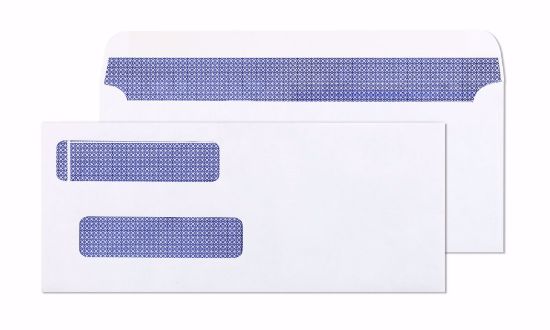
A double window envelope has two poly windows: the upper left window shows your business name and return address, and the lower window shows the payee name and address. Both are printed on the check itself, so a correctly matched envelope means zero hand-addressing and zero label printing.
Two details matter beyond the windows:
Security tint. A printed interior pattern that stops routing and account numbers from being readable through the paper. Our double window envelopes include security tint as standard and are guaranteed to match our checks.
Window alignment with your check layout. Address positions differ slightly between check layouts, which is why envelopes designed for your specific checks beat generic office-supply envelopes. A window that clips half the ZIP code is a returned payment.
Self-Seal vs Gum Flap: Choosing the Closure
Both closures mail identically. The difference is speed and preference.
Gum flap. The traditional moisten-and-press seal. Reliable, familiar, and suited to smaller mail runs.
Peel and seal. Remove the liner, fold the flap, press. No moisture, no sponge, and much faster when accounts payable mails a stack of checks at once.
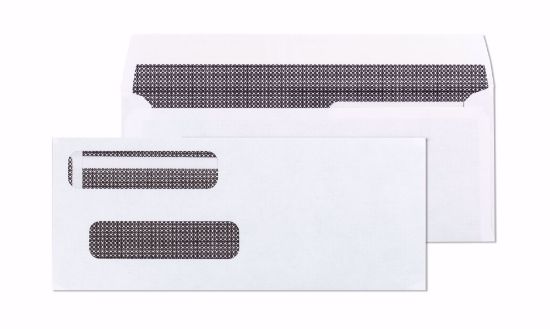
Our double window peel and seal envelopes add a black tint interior for extra confidentiality and are the convenient pick for mailing QuickBooks checks and invoices in volume.
How to Fold a Business Check for a Double Window Envelope
The fold is a Z-fold, and it takes four steps:
- Place the printed sheet face up with the check body panel in view.
- Fold along the perforations so the sheet forms a Z, with the check panel on the outside facing you.
- Slide the folded sheet into the envelope with the check panel facing the windows.
- Confirm both addresses are fully visible through the windows before sealing. Check the first envelope of every run, then batch the rest.
If an address sits half out of the window, the fold landed off the perforation or the envelope does not match the check layout. Fix it on envelope one, not envelope forty.
Envelopes for QuickBooks Checks
QuickBooks prints the payee address on the check in a fixed position, which is exactly what double window envelopes are designed around. Voucher checks from QuickBooks checks fold so the check panel faces the windows, and the addresses QuickBooks printed do the rest.
The practical tip: order envelopes and checks together. One order means one shipment, one delivery date, and envelopes guaranteed to match the checks in the same box, which matters most when the mail run is tomorrow.
Wallet and Personal Check Envelope Sizes
Not every check in a business travels on a full 8.5 x 11 sheet. Owner draws, reimbursements, and payments from personal accounts often go out on wallet-size checks, and those need a different envelope answer.
A wallet or personal check measures about 6 x 2.75 inches, which means it fits comfortably inside a standard #6 3/4 personal envelope, a #9, or even a #10 with room to spare. Because the check is smaller than the envelope in every direction, window alignment is not the concern it is with full-sheet business checks. The address simply gets written or printed on the envelope face.
Two practical notes for mixed offices that run both sizes:
Keep the stocks separate. A wallet check slipped into a batch of full-sheet voucher checks will rattle loose inside a check-size double window envelope, and a loose check is how addresses disappear behind paper edges in the mail.
Personal size does not mean personal account only. QuickBooks Desktop prints wallet checks for business accounts too, so if your office uses that format, size your envelope purchase to match both check types you actually mail in a month.
Mailing Business Checks Safely
The envelope is the only thing standing between your account details and everyone who handles the mail. A few habits make it a much better guard.
Use security tint, always. Hold a plain white envelope with a check inside up to a bright light and the routing line reads straight through the paper. Security-tinted envelopes exist to defeat exactly that. Both our gum flap and peel-and-seal double window envelopes carry the tint as standard.
Mail from a secure point. Checks left in an unattended outgoing mailbox with the flag up are the easiest target there is. Hand batches to your carrier, use a collection box near its pickup time, or drop them at the post office.
Seal completely. A gum flap pressed for a second along its full length, or a peel-and-seal liner removed entirely before pressing, keeps a corner from lifting in sorting machines. Lifted corners snag, and snagged envelopes tear.
Record before you mail. Check number, payee, amount, and date, either on the stub or in your register. If an envelope ever goes missing, that record is what makes the stop payment call fast instead of frantic.
Envelope security and check security work as a pair. The envelope hides the document in transit, and the check stock defends itself if the envelope is breached, which is why matched checks and envelopes ordered together beat mixing suppliers.
Quick Buying Checklist
- Match the envelope to the check, not the other way around. Check-specific double window envelopes align with printed address positions.
- Insist on security tint. Your account details should not be readable through the envelope under a light.
- Pick the closure for your volume. Gum flap for occasional mailing, peel and seal for regular batches.
- Order with your checks. Same shipment, same arrival, guaranteed match.
About the Author
This guide was written by the Checks Next Day production team, which has printed business checks and matched check envelopes for companies across the United States since 1997. The team works daily with check sheet layouts, window placement, and mailing specifications, and reviews every guide against current production standards before publishing.