- - -
- hours mins seconds
to get your checks by
Tomorrow, Sep. 25th

 0
0 You have no items in your shopping cart.
Blank Check Security Features: Holograms, Watermarks and Fraud Protection
A blank check hologram is a metallic foil graphic embedded in check stock that shifts appearance when tilted, making the document nearly impossible to photocopy or scan convincingly. It works alongside watermarks, microprinting, and chemically reactive paper to form the layered security that separates high security check paper from plain printer paper.
If you are comparing blank checks for your business, the security layer is the part you cannot see in a product photo and the part that matters most the day someone tries to tamper with a payment. This guide explains every major feature in plain English, what each one actually stops, and how to verify them on the checks in your drawer.
Why Blank Check Security Matters More Than Ever
A business check carries your routing number, account number, business name, and a signature sample on a single piece of paper. That makes every check a target for three kinds of fraud.
Check washing. Criminals use household chemicals to erase the payee or amount and rewrite the check to themselves.
Counterfeiting. A stolen or intercepted check is scanned, copied, and reprinted in bulk.
Alteration. Printed details are scraped, lifted, or overwritten on the original document.
No single feature stops all three. That is why quality check stock layers multiple defenses, and why knowing what each layer does helps you order the right paper instead of the cheapest one.
What Is a Blank Check Hologram?
A hologram on a check is a three-dimensional foil graphic bonded into the paper during production. Tilt the check and the image shifts color or depth. That optical movement is the entire point: photocopiers and scanners capture a flat image, so a copied check shows a dull gray patch where the hologram foil should shimmer.
Holograms defend against counterfeiting specifically. They do not stop washing or alteration, which is why hologram checks still need chemically reactive paper underneath.
How to verify a hologram in two seconds: hold the check flat, then tilt it toward a light source. A genuine foil shifts and reflects. A printed imitation stays flat and identical from every angle.
The Full Stack of Check Security Features
Here is what each feature does and the fraud it is built to stop.
Void Pantograph
A hidden pattern in the check background, invisible during normal use. Photocopy the check and the word VOID appears across the duplicate, because copiers cannot reproduce the subtle color difference between the pattern dots and the background.
Microprinting
Tiny text, often along the signature line or border, that reads as a solid line to the naked eye. Copiers and scanners cannot resolve characters this small, so on a counterfeit the microprint dissolves into a blurred smudge that bank equipment and trained staff can spot.
Chemically Reactive Paper (Chemical Wash Protection)
The paper is treated with compounds that react to bleach, acetone, and other washing agents. Any attempt to chemically erase the payee or amount leaves visible stains or discoloration, so a washed check announces itself the moment it reaches a teller.
Check Watermark
A design pressed into or printed onto the paper that is visible when held at an angle or up to light, but does not reproduce on photocopies. Watermarks give the person receiving a check a fast, no-equipment way to confirm they are holding an original document.
Security Screen
Faint background wording, such as ORIGINAL DOCUMENT, printed on the back of the check. Like microprint, it blurs or vanishes on copies.
Toner Adhesion
A coating that bonds laser printer toner tightly to the paper. Without it, printed details can be lifted off with tape or scraped away and retyped. This feature matters most on blank check stock, because everything critical on a blank check is applied by your own laser printer.
Heat-Sensitive Ink
An ink patch that fades or changes color from the warmth of a fingertip, then returns as it cools. Copies cannot reproduce the effect, which makes it a quick authenticity test anyone can perform.
Which Feature Stops Which Fraud
| Security feature | Check washing | Counterfeiting | Alteration |
|---|---|---|---|
| Hologram foil | No | Yes | No |
| Void pantograph | No | Yes | No |
| Chemically reactive paper | Yes | No | Partial |
| Microprinting | No | Yes | No |
| Watermark | No | Yes | No |
| Toner adhesion | Partial | No | Yes |
| Heat-sensitive ink | No | Yes | No |
Read the table vertically and the lesson is clear: a check protected by only one feature is protected against only one kind of fraud. Layers are the strategy.
The Padlock Icon: What It Certifies
The small padlock icon printed on many business checks is not decoration. It is an industry mark administered by the Check Payment Systems Association, and a check may only display it when the document includes a minimum set of fraud deterrents. A matching notice on the back of the check lists the features present.
For anyone receiving a check, the padlock is a fast signal that the document was produced on secured stock. When you order checks, it is the simplest single marker of a serious security standard.
High Security Check Paper vs Standard Stock
Basic commercial check stock typically carries a simple void pantograph and little else. High security check paper layers most or all of the features above into one sheet.
For blank check stock, the difference matters twice. First, the paper itself is the product: your printer adds the bank details, so the stock must carry the security. Second, blank checks print with MICR toner, and a toner adhesion coating protects exactly that printed MICR line and payment data from being lifted or altered after printing.
Our blank checks are produced on secured stock with built-in security features, are compatible with QuickBooks and other major accounting software, and ship the same day when ordered before 2:00 PM EST.
How to Verify Security Features in 60 Seconds
Run this quick test on any check stock you receive:
- Tilt it. A genuine hologram shifts and reflects light. Heat-sensitive patches respond to a fingertip.
- Hold it to light. A watermark should appear at an angle and disappear face-on.
- Photocopy one. The word VOID should surface on the copy, and microprint should blur into a broken line.
- Check the back. Look for the padlock icon notice and the list of included features.
- Inspect the borders. Run a magnifier along the signature line to confirm the microprinting is real text, not a printed line.
Choosing Secure Blank Checks for Your Business
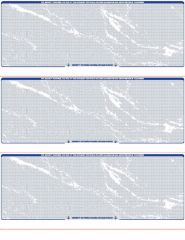
Blank checks come in four layouts: check on top, check in middle, check on bottom, and three per page. The layout you choose follows your accounting software, and the security travels with the paper regardless of position.
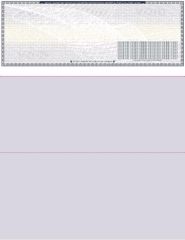
Choose blank checks on top for the voucher-style position most payroll and accounts payable software expects, or blank checks 3 per page when volume and economy lead the decision.
Prefer checks that arrive with your bank details already printed, so no MICR toner is needed at all? Computer checks are the pre-printed alternative, with the MICR line applied to banking specifications before the box ships. You can compare every format we produce from our business checks hub.
Office Habits That Complete the Protection
Even the most secure paper cannot protect a check that is handled carelessly. Three habits close the remaining gap.
Store blank stock like cash. A locked drawer or cabinet, with access limited to the people who print checks. Blank stock is more sensitive than pre-printed checks because a thief can print any account details onto it.
Reconcile quickly. Compare your check register against your bank statement every cycle. Washed and counterfeited checks are caught fastest by the bookkeeper who notices a payee or amount that does not match.
Control the print run. Print checks in numbered sequence, account for spoiled sheets, and never leave finished checks sitting in the printer tray.
About the Author
This guide was written by the Checks Next Day production team, which has printed and shipped secured business checks across the United States since 1997. The team works with security check stock, MICR printing standards, and accounting software formats every day, and reviews each guide against current industry specifications before publishing